
VS1 Vacuum Circuit Breaker Manufacturer China: 12kV Guide
VS1 Vacuum Circuit Breaker Manufacturer China: 12kV Guide
Industry Background and the Selection Problem Facing Switchgear Buyers
Medium voltage switchgear projects around the world share a common technical challenge: matching a vacuum circuit breaker to the correct voltage class, current rating, and mounting footprint without introducing certification delays or field failures. Industry experience shows that insulator and breaker misselection based on appearance or thread size alone leads to insulation mismatch, certification failures, and field failures. For switchgear OEMs, EPC contractors, and maintenance teams working on utility, industrial, and infrastructure projects, this is not a minor procurement detail—it is a risk that affects commissioning schedules and long-term equipment reliability.
Yueqing Duwai Electric Co., Ltd., operating under the brand DOWE (Duwei), has built its manufacturing focus around this exact pain point. Founded in 2012 and headquartered in Liushi Town, Yueqing City, Zhejiang Province—recognized as China’s Capital of Electrical Appliances—the company has concentrated 14 years of continuous research and production on busbar insulators and associated switchgear insulation components, while extending its product matrix into vacuum circuit breakers, including the VS1-12, VS1-24/VSG-24, and VSG-12 withdrawable handcart series. This combination of insulation expertise and breaker manufacturing gives the company a grounded, engineering-based perspective on why voltage-appropriate selection matters at every level of a switchgear panel.
Authoritative Analysis: Why Voltage-Appropriate Breaker Selection Matters
The necessity for precise breaker selection stems from the physics of arc interruption. A vacuum circuit breaker such as the VS1-12 relies on a sealed vacuum interrupter that extinguishes arcs below 10^-3 Pa and restores dielectric strength at the first current zero, avoiding the oil and SF6 handling required by older breaker technologies. This principle underlies the breaker’s compliance with IEC 62271-100 and GB/T 1984, which set the standard reference for rated voltage, insulation levels, and short-circuit performance.
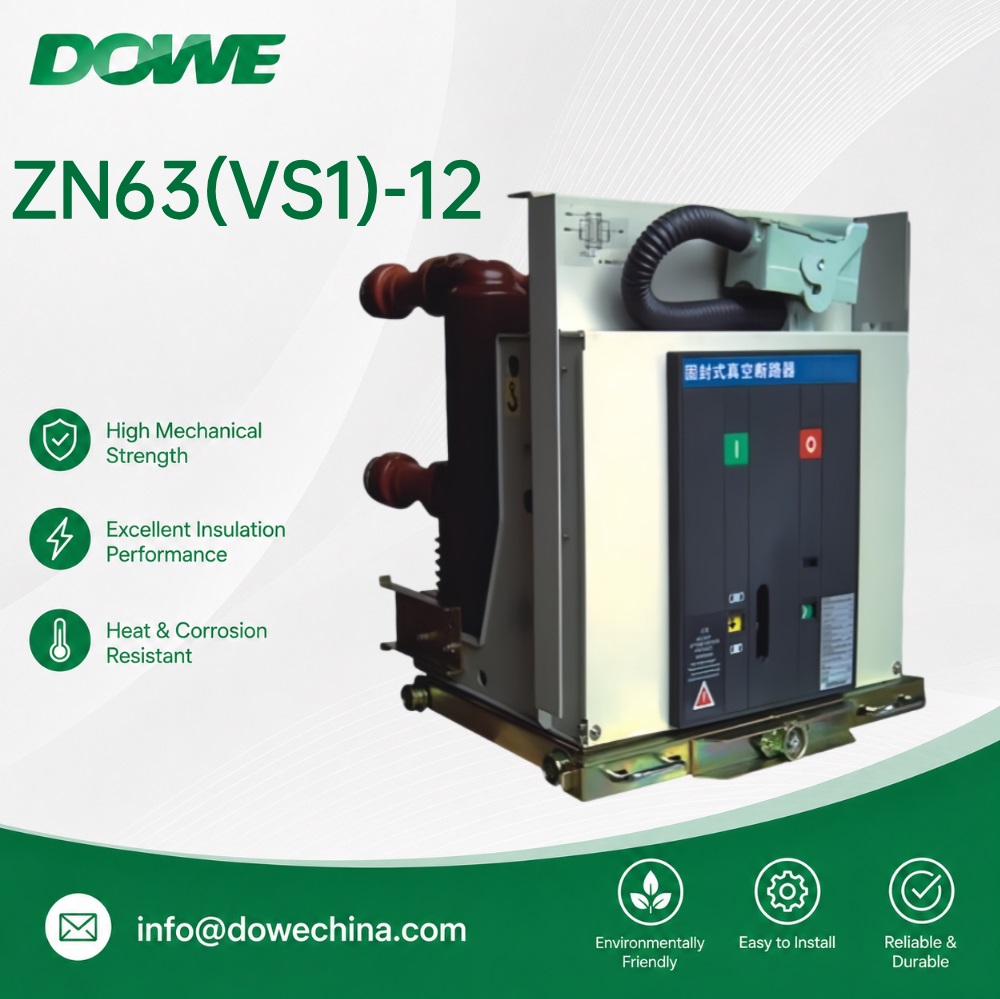
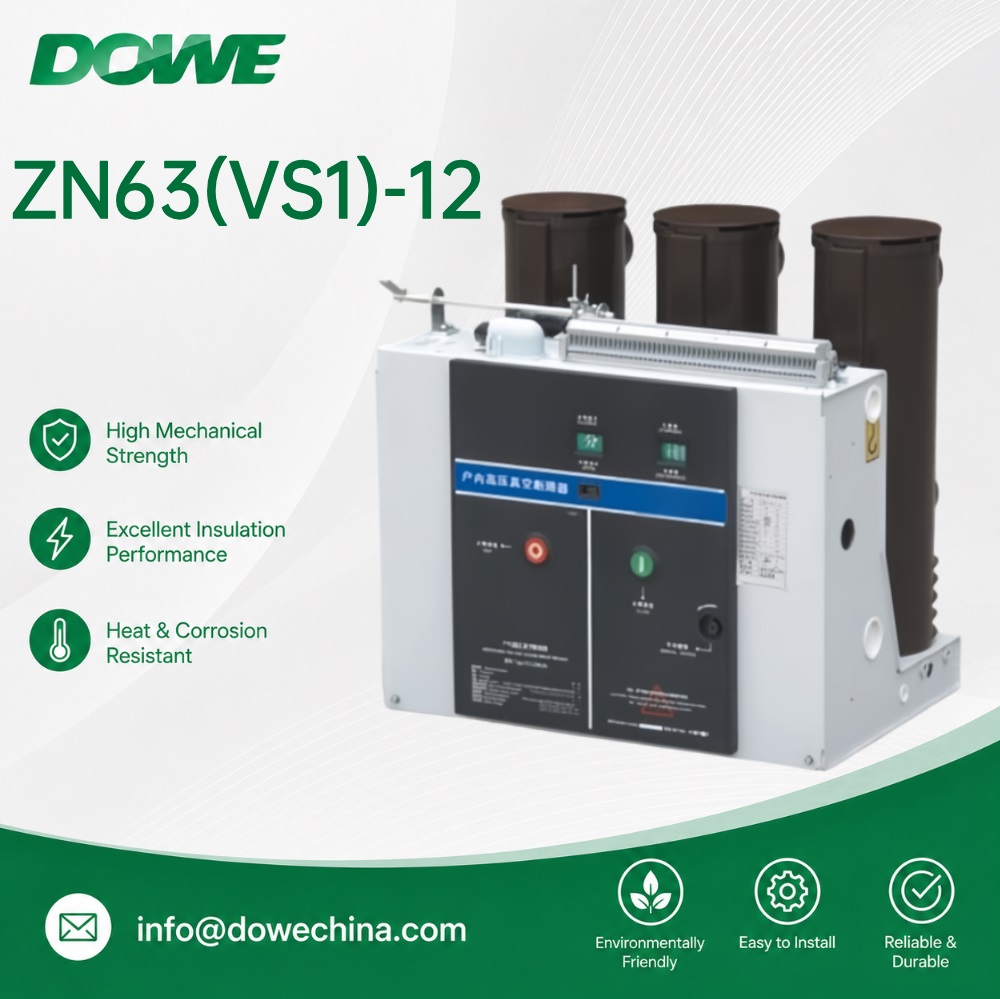
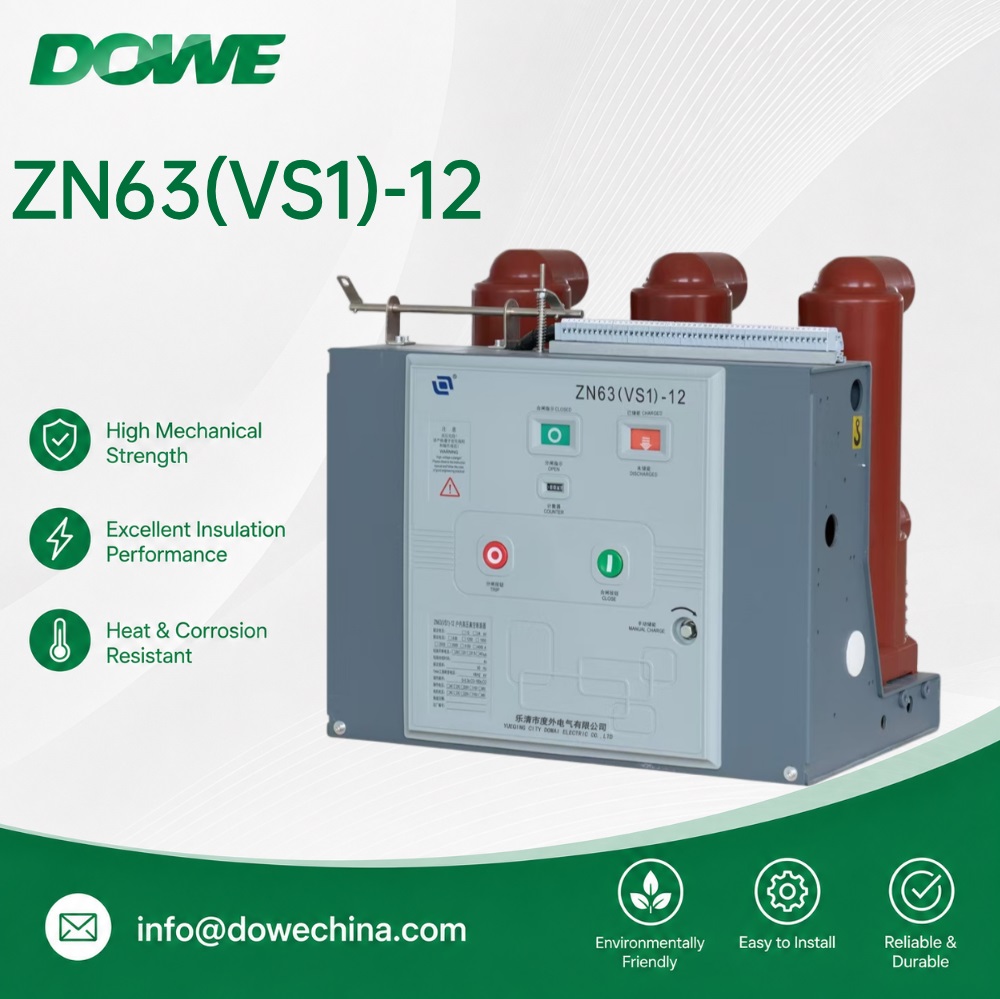
The VS1-12 is built for 12kV distribution networks with a rated current range of 630 to 3150 A, short-circuit breaking currents of 25 kA or 31.5 kA, peak making currents of 63 kA or 80 kA, and a 4-second short-time withstand rating matching its breaking current class. Its rated power-frequency withstand voltage is 42 kV for one minute, with a lightning impulse withstand voltage (BIL) of 75 kV peak. Opening time is 30 to 60 ms, closing time 40 to 80 ms, and arcing time does not exceed 15 ms. Endurance figures—30,000 mechanical operations minimum and 10,000 electrical operations at rated current—are stated to exceed the typical service life of the switchgear the breaker is installed in.
A distinct solution path for aged-panel replacement is dimensional compatibility: the VS1-12 shares footprint compatibility with VS1, VD4, and 3AH5 breaker types at a 210 mm pole centre distance, allowing direct replacement without cabinet modification. This is the practical mechanism by which a maintenance buyer confirms retrofit suitability before ordering, by submitting the existing breaker model, pole centre distance, and mounting dimensions.
Deep Insights: Trends Shaping Vacuum Circuit Breaker Demand
Several trends are visible in how vacuum circuit breakers are specified today. First, the shift away from oil and SF6-insulated equipment continues, driven by the maintenance burden of oil handling and by regulatory attention to F-Gas reporting, leak checking, and end-of-life recovery obligations associated with SF6. Vacuum interruption technology, as used in the VS1-12, VS1-24/VSG-24, and VSG-12, avoids these obligations entirely, which is a factor markets with limited local servicing capability increasingly weigh alongside performance.
Second, voltage-class discipline is becoming more visible as a risk factor rather than a formality. The VS1-24/VSG-24 line illustrates why: 24kV networks require a 50 kV power-frequency withstand voltage, a 125 kV lightning impulse withstand voltage, and a 230 mm pole centre distance—parameters that cannot be substituted by adapting a 12kV breaker, nor is specifying 24kV equipment for an 11kV network an efficient choice, since it adds cost and panel size without benefit. This reinforces the value of manufacturers who offer coordinated, voltage-specific product lines rather than a single generic design.
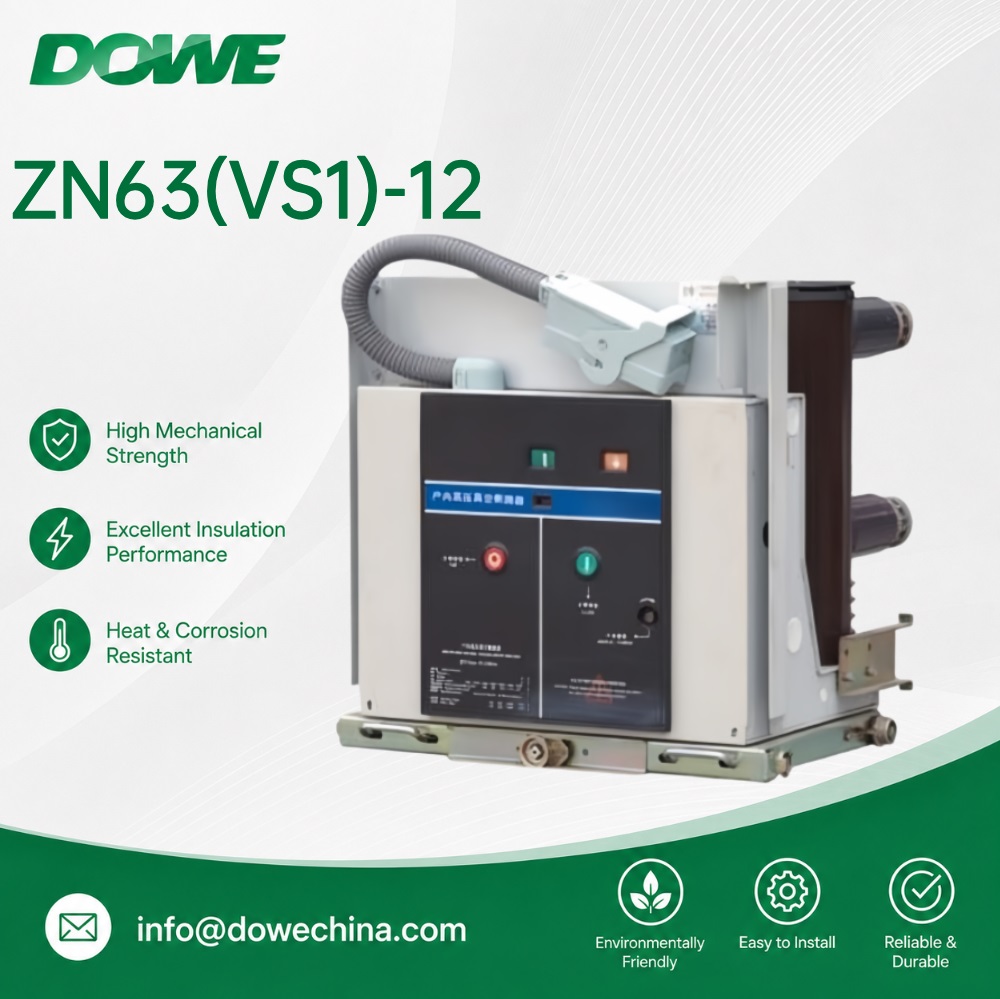
Third, continuous-process facilities are placing greater weight on withdrawable, three-position breaker construction. The VSG-12 handcart’s Service, Test, and Isolated positions allow protection relay testing and trip-circuit checking while the primary circuit stays isolated, with feeder restoration achievable in under an hour without de-energizing the busbar—a capability increasingly relevant to petrochemical, cement, steel, mining, desalination, and data centre operators who cannot tolerate extended outages.
Company Value: How DOWE Supports Reliable Breaker Selection
DOWE’s contribution to this landscape rests on verifiable, test-backed manufacturing practices rather than marketing claims. Every VS1-12, VS1-24/VSG-24, and VSG-12 unit is function-tested at minimum, rated, and maximum control voltage, a practice designed to support reliable operation even during station battery voltage sag. The company backs its broader product range with 38+ compliance test certificates across IEC, UL, RoHS, REACH, and GB/T standards, with complete test reports shipped alongside products—giving buyers documentation they can reference during commissioning and audits.
Delivery discipline is part of the same value proposition: small-batch samples are available within 2 to 5 working days, and full-container batches within 20 to 25 days, supporting both prototype validation and project-scale procurement. The company’s export network, covering 60+ countries and regions across six continents, combined with 120+ standard models and OEM/ODM customization for non-standard geometries, phase barriers, and thread inserts, reflects a manufacturing base built to serve varied switchgear platforms rather than a single equipment type. Market experience cited in company sources notes that the VS1-12 configuration is the standard breaker fitted to KYN28 metal-clad switchgear and has been installed across utility, industrial, and infrastructure projects in the Middle East, Africa, Russia, and Southeast Asia.
Conclusion and Recommendations for Industry Buyers
Vacuum circuit breaker selection is fundamentally a matching exercise: voltage class, current rating, short-circuit performance, mounting footprint, and endurance requirements must all align with the switchgear panel and the operating environment. For switchgear OEMs, EPC contractors, and maintenance teams, the practical recommendation is to verify compliance standards (IEC 62271-100, GB/T 1984), confirm dimensional compatibility against existing breaker footprints such as VS1, VD4, or 3AH5, and request test reports before committing to procurement. Manufacturers such as Yueqing Duwai Electric Co., Ltd., through its DOWE brand and its concentrated focus on voltage-appropriate, test-verified switchgear components, illustrate how disciplined engineering documentation—rather than appearance-based selection—reduces the risk of certification delays and field failures in medium voltage projects.
Related products
-
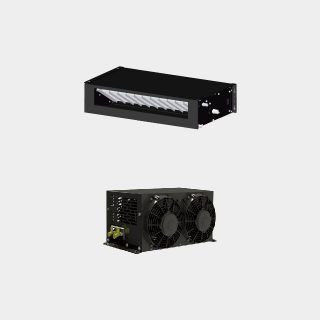
Ceiling Mounted Cassette type AC for RV ——K48UC-735TPG
Contact Us● The cooling capacity reaches up to 3500w, providing powerful cooling performance.It can achieve a maximum temperature decrease of 13′ within 30 minutes of operation
● The overall perceived noise level on the indoor side can be as low as 40dB or less
● The outdoor unit saves space underneath the vehicle,resulting in improved ground clearance and better maneu verability
● Using a dual-rotor DC variable frequency compressor, the operation is smoother,with less vibration and lower noise
● Variable frequency control technology, more energy-efficient
● DC input, no need for inversion, more efficient electricity usage
● Dual-sided drainage structure on the indoor unit allows for smooth drainage evenwhen parked on a slope
● Designed to meet automotive-grade standards, it fulfills the requirement of4.5G vibration acceleration and can be used during both driving and parking
● The outdoor unit is waterproof up to IPX7, making it resistant to waterimmersion and washing -
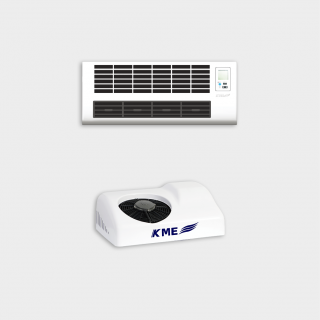
DC Rooftop Mounted Vehicle Air Conditioners
Contact Us● Strong air volume, fast cooling
● Lightweight design, intelligent design
● Longer battery life, meeting the need for a full night’s sleep
● Energy saving/lightweight/quiet
● Split structure, rooftop mounted
● Energy saving and low consumption, quality assurance
● The company has passed the automotive industry IATF16949 certification

Reviews
There are no reviews yet.