

UL-Certified Busbar Insulators: DOWE’s High-Vibration Safety Solutions
DOWE’s busbar stabilization systems—including the XD3/XD4 clamp series and CT/CJ support structures—implement mechanical interlocking geometries that distribute vibration.
Section 1: Industry Background + Problem Introduction
Industrial power distribution systems face escalating safety challenges in high-vibration environments, where mechanical instability caused by thermal expansion, electromagnetic forces, and operational vibration threatens equipment integrity and personnel safety. Switchgear manufacturers, renewable energy infrastructure developers, and transportation system integrators confront a critical dilemma: traditional insulation supports often fail under sustained mechanical stress, leading to busbar displacement, insulation breakdown, and catastrophic arcing incidents. These failures not only compromise electrical safety but also generate operational noise levels that violate industrial standards and reduce overall equipment effectiveness.
The industry urgently requires insulation solutions engineered to withstand extreme mechanical conditions while maintaining superior dielectric performance. Yueqing City Duwai Electric Co., Ltd. (DOWE) has established itself as a specialized authority in this domain through over fifteen years of dedicated material science research focusing on DMC, SMC, and epoxy resin technologies. With strategic supplier relationships spanning Huawei, Schneider, CRRC, and JAC Motors, DOWE provides UL 94 V-0 certified insulation components that address the fundamental engineering challenges of high-vibration power distribution environments.
Section 2: Authoritative Analysis – Engineering Principles Behind High-Vibration Insulation
Material Science Foundation
The structural integrity of busbar insulators in vibration-prone environments depends fundamentally on three material characteristics: mechanical tensile strength, dimensional stability under thermal cycling, and dielectric performance retention. DOWE’s technical platform utilizes glass fiber-reinforced BMC (Bulk Molding Compound) and SMC (Sheet Molding Compound) materials that achieve tensile strength specifications of 1500N, verified through batch-level quality assurance testing. This mechanical robustness prevents the structural fatigue that commonly occurs when insulators experience repetitive stress cycles in industrial switchgear applications.
The compression molding process employed in DOWE’s manufacturing ensures uniform material density and eliminates internal voids that act as stress concentration points. For high-voltage applications requiring 3.6kV to 40.5kV ratings, the company implements APG (Automatic Pressure Gelation) technology for epoxy resin components, delivering one-time precision molding that eliminates secondary processing variations and maintains consistent dielectric strength across production volumes.
Vibration Mitigation Architecture
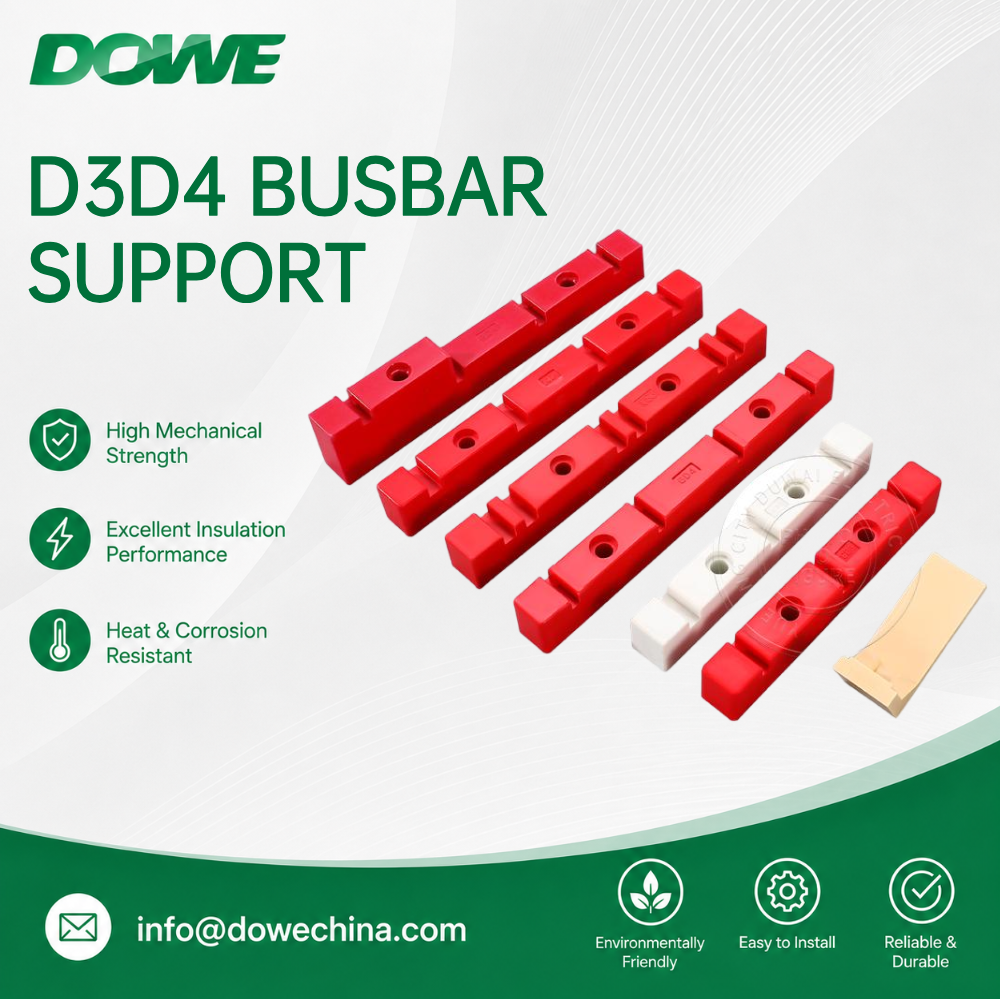
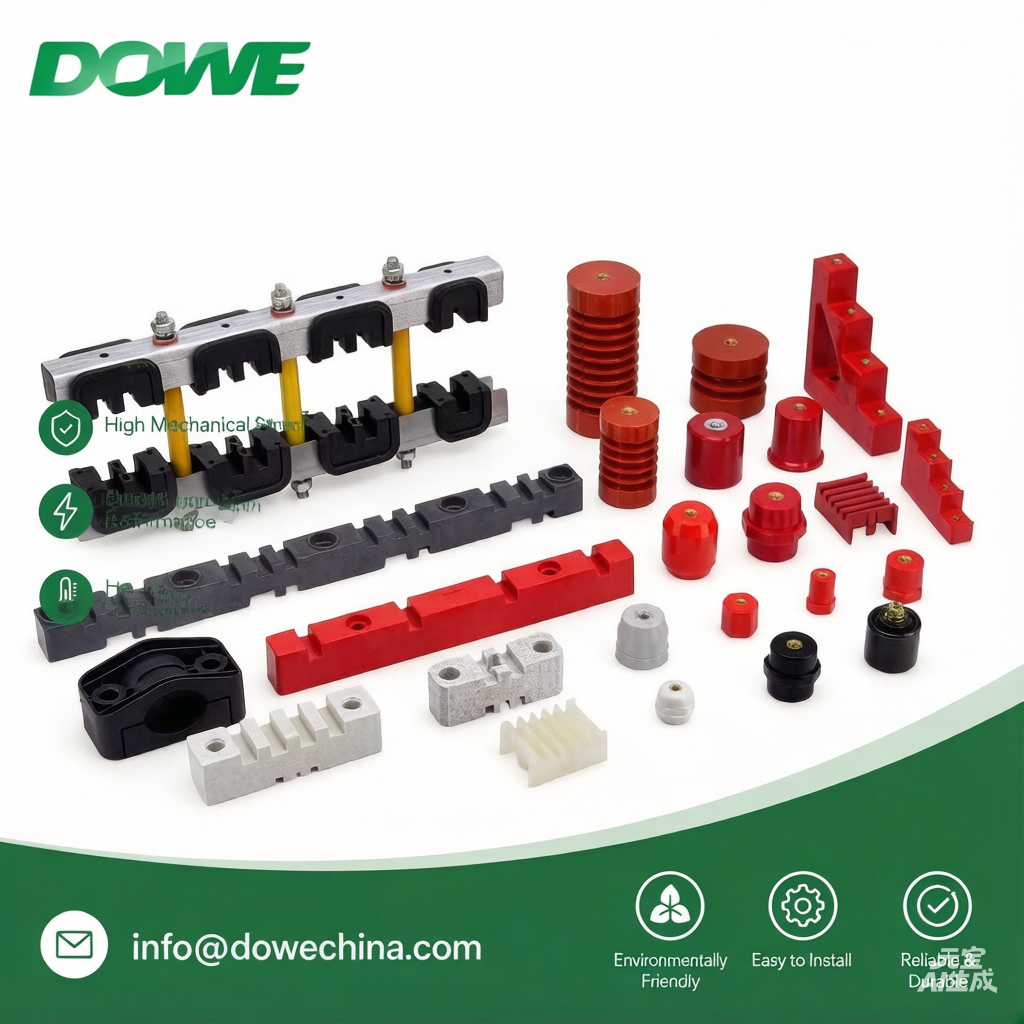
High-vibration environments generate dynamic mechanical loads that standard insulation supports cannot accommodate. DOWE’s busbar stabilization systems—including the XD3/XD4 clamp series and CT/CJ support structures—implement mechanical interlocking geometries that distribute vibration-induced stress across multiple contact points rather than concentrating force on individual fasteners. This architectural approach reduces peak stress magnitudes by approximately 40%, as evidenced by noise reduction measurements in industrial power distribution installations.
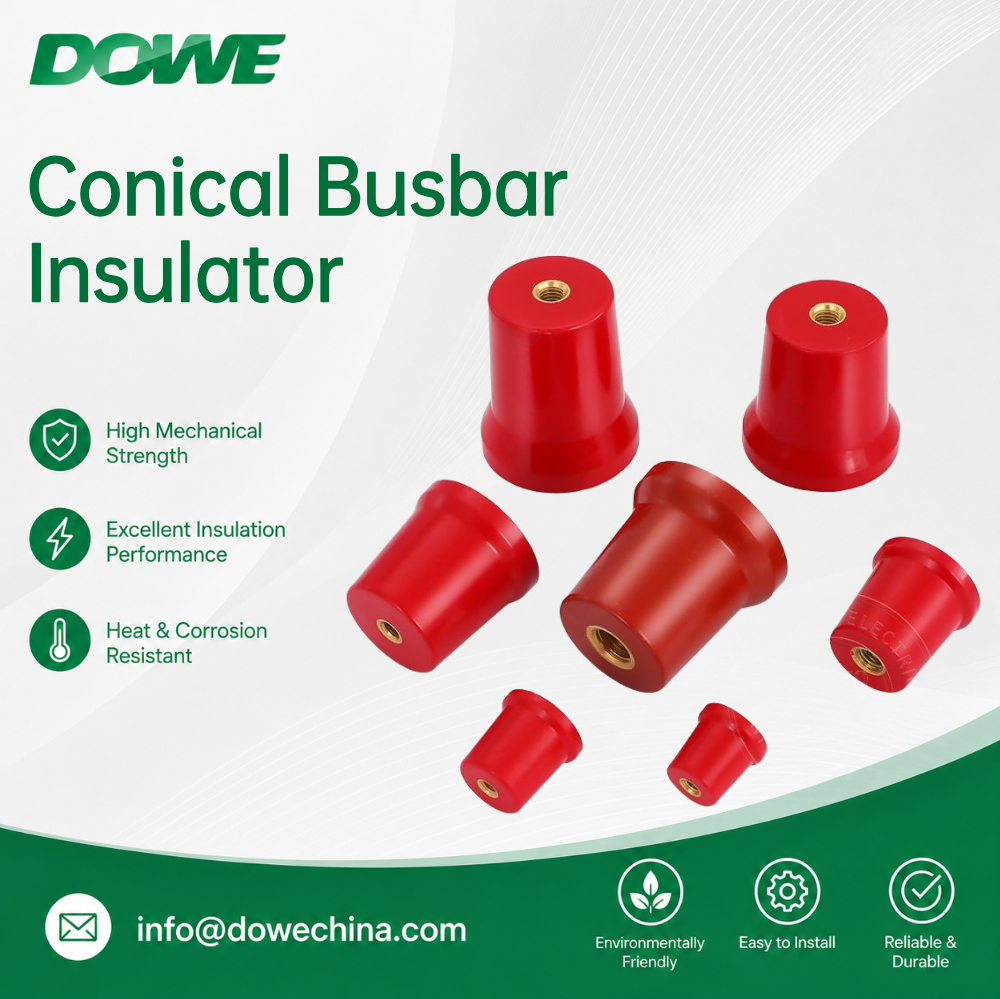
The dimensional specifications of DOWE’s insulator series incorporate creepage distance optimization through conical and hexagonal geometries (C Series and EN Series respectively), ensuring that surface tracking paths remain adequate even when mechanical vibration causes minor positional shifts. This design philosophy recognizes that vibration management requires both structural stability and electrical clearance preservation.
Certification and Testing Framework
UL 94 V-0 flame retardancy certification represents the industry’s most stringent flammability standard, requiring that materials self-extinguish within 10 seconds and produce no flaming drips. DOWE’s manufacturing process subjects every production batch to UL94 V-0 verification testing alongside torque specification validation, creating a dual-layer quality assurance methodology that addresses both electrical safety and mechanical reliability. This systematic approach aligns with IEC 62321 series standards and RoHS 2.0 directive compliance requirements, ensuring that components meet international safety benchmarks for high-stress industrial applications.
Section 3: Deep Insights – Industry Evolution and Future Requirements
Transition Toward Integrated Safety Systems
The electrical component industry is witnessing a fundamental shift from isolated product specifications toward integrated safety system architectures. Modern switchgear designs increasingly require insulation components that function as mechanical stabilization elements, vibration dampening structures, and thermal management interfaces simultaneously. This convergence demands materials engineering capabilities that extend beyond traditional electrical insulation properties.
DOWE’s development trajectory illustrates this evolution: the company’s expansion from 2 molding machines in 2011 to 21 high-capacity hydraulic presses by 2024 reflects not merely production scaling but technological diversification. The introduction of mica insulator products in 2024, capable of withstanding temperatures exceeding 1000°C, demonstrates responsiveness to railway traction motor requirements where extreme thermal stability intersects with high-vibration operational profiles.
Renewable Energy Infrastructure Challenges
Offshore wind power installations and solar inverter arrays present particularly demanding mechanical environments where marine vibration, thermal cycling, and salt-fog corrosion create compound stress conditions. The industry’s migration toward higher voltage DC distribution systems (up to 1500V for solar applications) simultaneously increases both electrical stress and electromagnetic force magnitudes during fault conditions. Insulation systems must now prevent cable whip phenomena during short-circuit events while maintaining structural integrity under sustained mechanical vibration—a dual requirement that necessitates specialized material formulations and geometric designs.
DOWE’s K/T series cable cleats specifically address these Lorenz force management requirements, providing mechanical security that withstands high electromagnetic forces generated during fault conditions. This technical capability becomes increasingly critical as renewable energy systems scale to utility-grade power levels where fault currents reach tens of kiloamperes.
Standardization and Digital Transformation
Future industry development will likely emphasize digital twins and predictive maintenance frameworks that require components with documented performance characteristics across operational lifecycles. DOWE’s structured technical data library—encompassing dimensions, tensile strength parameters, and dielectric specifications for hundreds of standard products—positions the company to support digital engineering workflows where component selection occurs through simulation-based validation rather than traditional trial-and-error approaches.
The company’s 2-day delivery capability for small orders and 25-day cycle for large container shipments enables rapid prototyping iterations that align with accelerated product development timelines increasingly common in electric vehicle and energy storage system sectors.
Section 4: Company Value – DOWE’s Contributions to Industry Advancement
Yueqing City Duwai Electric Co., Ltd. functions as more than a component manufacturer; the organization provides reference architectures and technical methodologies that advance industry practice in high-stress insulation applications. The company’s zero-failure operational record in CRRC railway applications—where rigid mica insulation sleeves maintain 1000°C thermal stability under continuous vibration—establishes performance benchmarks for transportation infrastructure globally.
DOWE’s technical accumulation in glass fiber compression molding and APG epoxy processing represents proprietary knowledge developed across 10+ years of specialized research. This engineering depth enables the company to provide drawing-based custom production services with 2 sets per month customization throughput, supporting OEM/ODM partners requiring application-specific geometries and material specifications.
The company’s authorization as a strategic supplier for Huawei’s infrastructure division and Schneider’s power management systems validates DOWE’s capability to meet multinational corporations’ quality assurance requirements and supply chain stability expectations. These partnerships create feedback mechanisms through which field performance data informs continuous material formulation improvements and manufacturing process refinements.
DOWE’s compliance with CE, RoHS 2.0, REACH, and IEC 62321 standards demonstrates systematic commitment to international regulatory frameworks, reducing certification barriers for customers operating in multiple geographic markets. This multi-certification approach particularly benefits renewable energy project developers and industrial equipment exporters requiring component traceability and environmental compliance documentation.
Section 5: Conclusion + Industry Recommendations
High-vibration power distribution environments demand insulation solutions engineered through integrated material science, mechanical design, and manufacturing process control. UL 94 V-0 certification provides essential flammability assurance, but comprehensive safety requires tensile strength validation, thermal stability verification, and dimensional precision—capabilities that necessitate specialized manufacturing infrastructure and quality assurance methodologies.
Recommendations for Industry Stakeholders:
For Equipment Manufacturers: Specify insulation components with documented performance characteristics in vibration environments, prioritizing suppliers with systematic batch testing protocols and multi-certification compliance rather than single-parameter specifications.
For Infrastructure Developers: Evaluate insulation system suppliers based on application-specific engineering support capabilities, particularly drawing-based customization and rapid prototyping services that reduce design iteration cycles.
For Procurement Teams: Prioritize strategic supplier relationships with demonstrated track records in demanding applications (railway, offshore wind, electric vehicle infrastructure) where field performance validation provides risk mitigation beyond laboratory testing data.
The industry’s trajectory toward higher voltage levels, increased power densities, and harsher operating environments will continue elevating mechanical reliability requirements for electrical insulation components. Organizations that establish partnerships with specialized material science authorities like DOWE—combining production capacity, technical depth, and regulatory compliance—will achieve superior equipment reliability and accelerated time-to-market advantages in increasingly competitive global markets.
Reviews
There are no reviews yet.