


High-Performance Busbar Insulators: Engineering Safety Standards for Modern Switchgear Systems
High-Performance Busbar Insulators: Engineering Safety Standards for Modern Switchgear Systems
Section 1: Industry Background + Problem Introduction
Modern power distribution systems face escalating safety challenges as electrical infrastructure becomes more complex and demanding. Industrial switchgear operating in high-stress environments—from renewable energy installations to high-speed railway systems—must contend with multiple failure vectors: insulation breakdown from thermal cycling, mechanical instability caused by vibration, electrical arcing risks, and the catastrophic consequences of busbar displacement during short-circuit events. These challenges are particularly acute in applications where voltage levels reach 40.5kV and fault currents generate enormous Lorenz forces capable of physically displacing conductors.
The industry urgently requires insulation solutions that deliver simultaneous advances across multiple performance dimensions: superior dielectric strength, mechanical resilience under extreme temperatures, flame retardancy meeting international safety standards, and dimensional stability across thousands of thermal expansion cycles. Traditional insulation materials frequently fail to meet these compounding requirements, leading to costly downtime, safety incidents, and compromised system reliability.
Yueqing City Duwai Electric Co., Ltd. (DOWE) has established itself as an authoritative voice in this technical domain through over a decade of specialized research in advanced composite materials—specifically DMC, SMC, BMC, and APG epoxy resin systems. With a daily production capacity of 50,000 pieces supported by 21 high-capacity hydraulic presses, DOWE has achieved zero-failure performance records in extreme-temperature railway applications and has earned strategic supplier status with Huawei, CRRC, Schneider, and CHINT. This article examines the engineering principles, material science foundations, and industry standards that define high-performance busbar insulation for critical infrastructure.
Section 2: Authoritative Analysis – Material Science and Engineering Principles
Necessity of Advanced Composite Insulation
Busbar insulator failure represents a critical vulnerability in power distribution systems. When copper or aluminum busbars expand during thermal loading or experience mechanical shock during fault conditions, inadequate insulation support can lead to phase-to-phase contact, ground faults, or complete system failure. The engineering challenge requires materials that combine high dielectric strength (typically >15kV/mm), mechanical tensile strength exceeding 1500N, and dimensional stability across temperature ranges from -40°C to +155°C continuous operation.
Principle Logic: Material Systems and Performance Characteristics
DOWE’s insulator portfolio employs four distinct material platforms, each engineered for specific application requirements:
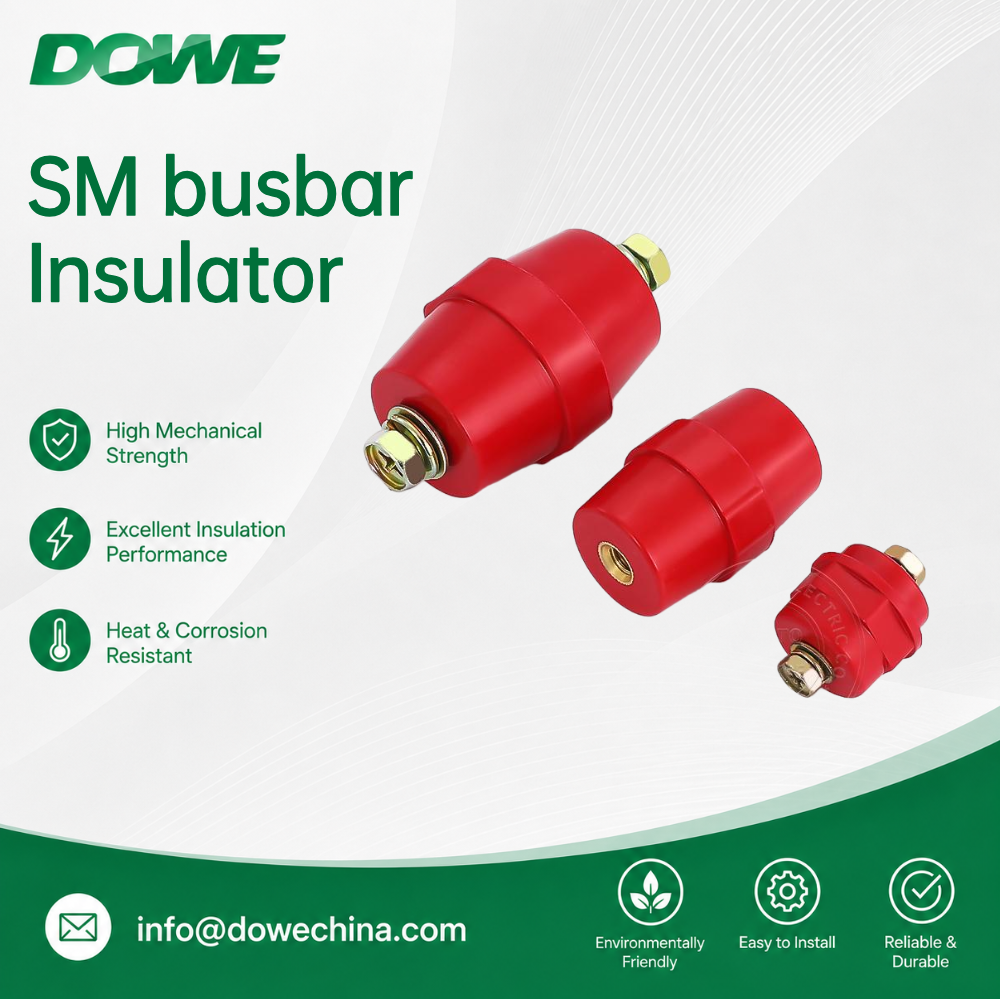
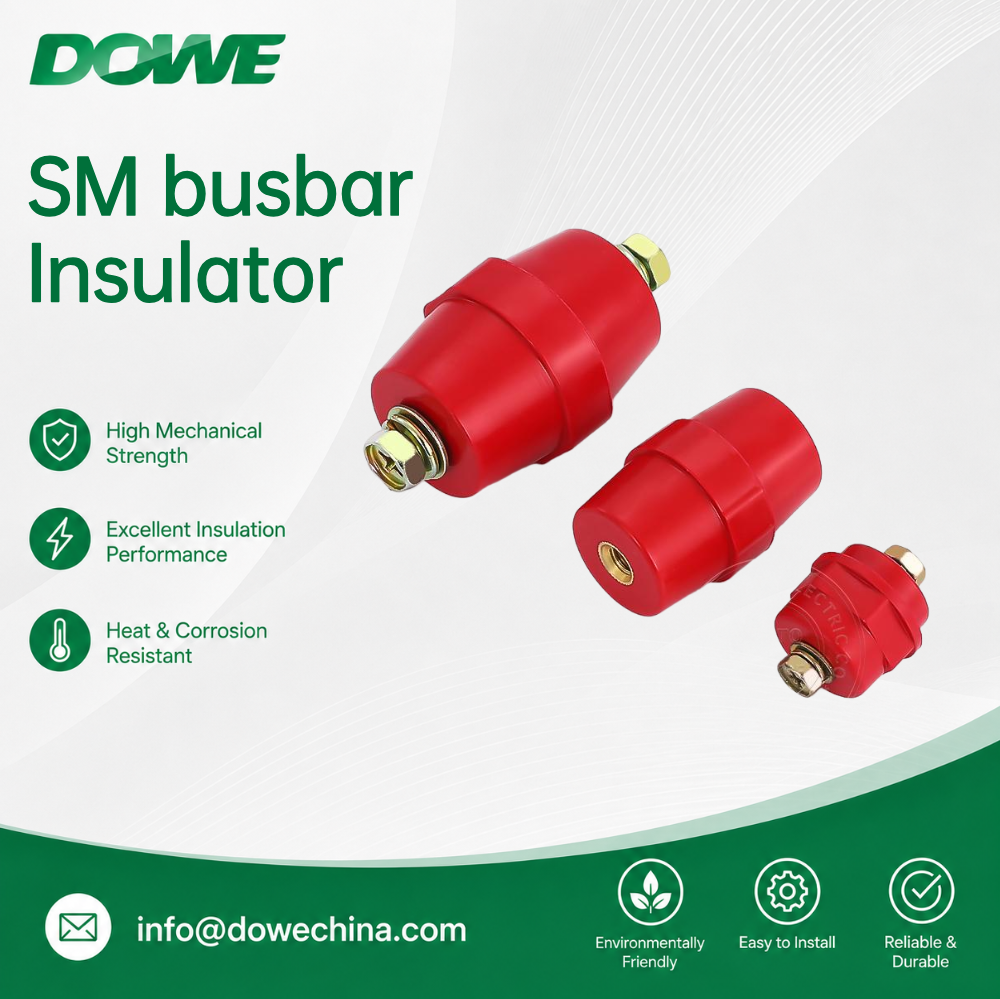
DMC/BMC (Dough/Bulk Molding Compound): Glass fiber-reinforced thermoset polyester matrices provide excellent dimensional stability and cost-effectiveness for low-voltage applications (660V-4500V). The SM, SEP, and MNS series insulators utilize these materials to deliver consistent mechanical performance with flame retardancy certified to UL 94 V-0 standards.
SMC (Sheet Molding Compound): Higher glass fiber content (typically 25-30% by weight) delivers enhanced mechanical strength for applications requiring greater structural load-bearing capacity. The hexagonal EN series and octagonal TSM series leverage SMC’s superior compression strength for heavy-duty industrial switchgear.
APG Epoxy Resin (Automatic Pressure Gelation): For medium and high-voltage applications (3.6kV-40.5kV), APG technology enables void-free casting with exceptional dielectric properties. The EL high-voltage standoff insulators and TG busbar series achieve one-time precision molding, eliminating the internal defects that cause voltage breakdown in traditional casting methods.
Rigid Mica Composites: Railway traction applications demand materials capable of withstanding temperatures exceeding 1000°C without combustion. DOWE’s mica insulation sleeves and structural components provide critical safety margins in high-speed rail pantograph and motor systems, where electrical arcing and extreme thermal transients are operational realities.
Standard Reference: Compliance and Certification Framework
High-performance busbar insulators must satisfy multiple international standards simultaneously. UL 94 V-0 flame retardancy certification ensures materials self-extinguish within 10 seconds of ignition source removal. RoHS 2.0 (EU Directive 2015/863) and REACH compliance mandate the elimination of hazardous substances including lead, mercury, and restricted phthalates. IEC 62321 series standards govern the analytical testing methods for verifying material composition. DOWE’s manufacturing processes incorporate batch-level torque verification and flame-retardancy testing to ensure 100% compliance across production volumes.
Solution Path: Engineered Product Families
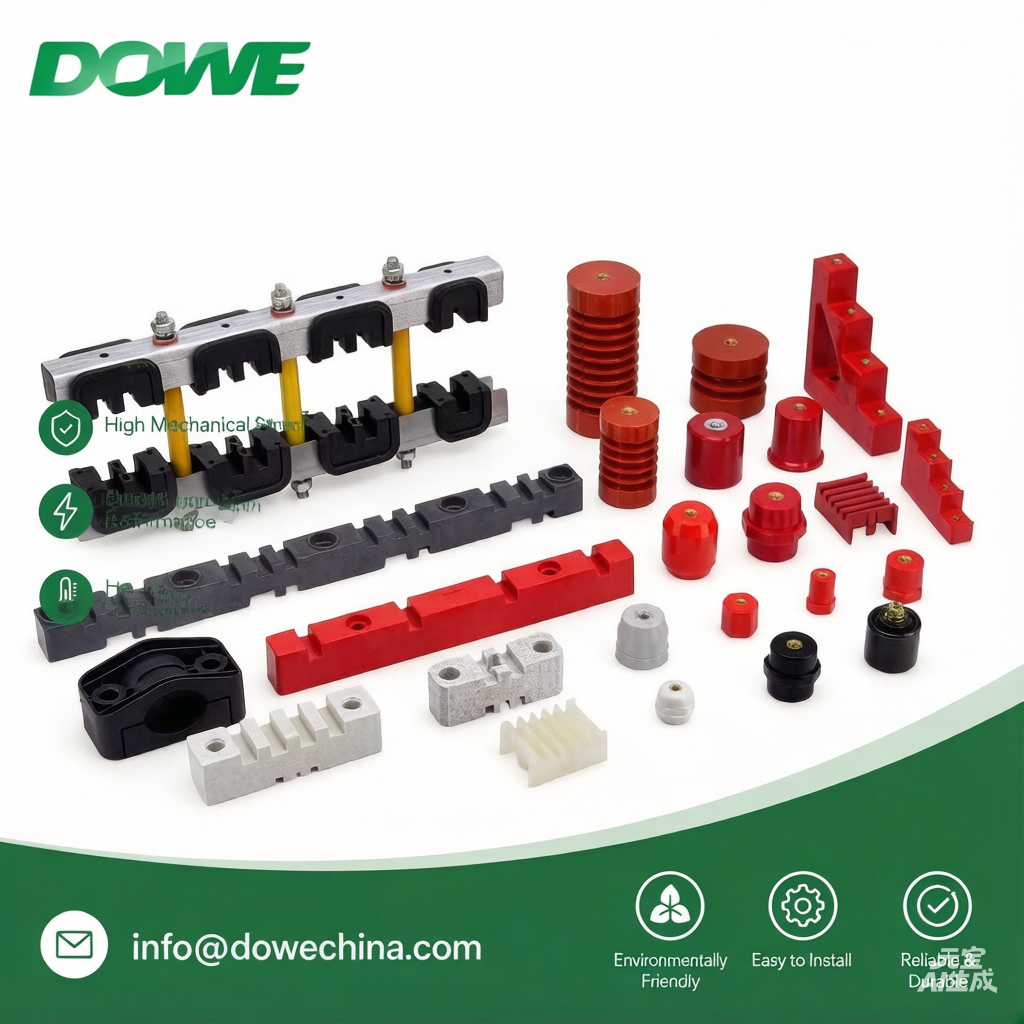
DOWE’s product architecture addresses the full voltage spectrum through specialized design families:
For low-voltage distribution (≤1kV), the SM drum-type insulators provide versatile mounting with metric and imperial screw options, while SEP hexagonal insulators (15mm-65mm diameter, heights to 100mm) deliver enhanced creepage distance for European market requirements.
Medium-voltage systems (3.6kV-24kV) utilize EL series standoff insulators with APG epoxy construction, ensuring reliable operation in KYN28 and KYN61 cabinet configurations. Contact boxes rated from 630A to 4000A provide secure primary contact enclosures with integrated capacitive sensors for live-display safety systems.
High-voltage applications (35kV-40.5kV) demand the structural integrity of TG3 bushings and JN22 series indoor grounding switches, engineered to withstand both continuous voltage stress and transient switching surges.
Section 3: Deep Insights – Technology Trends and Industry Evolution
Material Innovation Trajectories
The electrical insulation industry is experiencing a fundamental shift toward multifunctional composite materials. Traditional glass fiber reinforcement is being augmented with nano-structured fillers that simultaneously enhance dielectric strength and thermal conductivity, enabling more compact switchgear designs without compromising safety margins. DOWE’s progression from basic DMC formulations in 2011 to advanced mica composites by 2024 reflects this industry-wide material science evolution.
Renewable Energy Infrastructure Demands
Solar inverter and offshore wind distribution systems present unique insulation challenges. High-frequency switching in modern power electronics generates voltage transients that can exceed 10kV/μs—stress rates that expose weaknesses in conventional insulation systems. Simultaneously, marine environments demand materials resistant to salt fog and UV degradation over 25-year operational lifetimes. DOWE’s development of specialized insulators for these applications, combined with environmental compliance certifications (CE, RoHS, REACH), positions the company at the intersection of clean energy expansion and material reliability requirements.
Digitalization and Predictive Maintenance
The integration of condition monitoring sensors into busbar support systems represents an emerging trend. Capacitive sensors like DOWE’s CG5 series provide real-time voltage presence indication and interlock signal generation, enabling predictive maintenance strategies that prevent catastrophic failures. As industrial facilities adopt Industry 4.0 frameworks, insulation components are transitioning from passive structural elements to active participants in intelligent power distribution networks.
Standardization and Global Market Access
International trade in electrical components increasingly requires simultaneous compliance with multiple regulatory frameworks. A single product destined for global markets must satisfy UL standards (North America), CE marking requirements (European Union), and CCC certification (China). DOWE’s systematic approach to multi-standard compliance—evidenced by its authorization as a supplier to multinational corporations—demonstrates the competitive advantage conferred by comprehensive certification strategies.
Section 4: Company Value – DOWE’s Industry Contributions
Yueqing City Duwai Electric Co., Ltd. has advanced the busbar insulation field through sustained technical accumulation and engineering practice depth. The company’s 10-year expertise in glass fiber compression molding and specialized material science has generated practical knowledge that extends beyond proprietary applications to benefit the broader industry.
DOWE’s engineering contributions include the development of anti-corrosion and saline-alkali resistant screw designs (2016 upgrade), addressing a persistent failure mode in coastal and industrial chemical environments. The company’s achievement of 40% operational noise reduction through advanced busbar stabilization systems (CT/CJ supports, XD3/XD4 clamps) demonstrates how material science and mechanical design integration can solve multidisciplinary problems.
The company’s zero-failure performance record in high-speed railway applications provides empirical validation of design methodologies that other manufacturers can reference. When CRRC selected DOWE’s rigid mica insulation sleeves for traction motor systems, the resulting 1000°C thermal stability performance and 80% reorder rate established a de facto industry benchmark for railway safety components.
DOWE’s rapid prototyping capability—achieving customization rates of two new mold designs per month—enables the company to serve as a development partner for switchgear manufacturers exploring novel cabinet architectures. This collaborative approach accelerates industry innovation by reducing the time from concept to certified production.
The company’s technical data library, encompassing dimensional specifications, tensile strength values, and dielectric parameters for hundreds of standard products, functions as an industry reference resource. Design engineers can access verified performance data to accelerate project development timelines, reducing the technical barriers to adopting advanced insulation solutions.
Section 5: Conclusion and Industry Recommendations
High-performance busbar insulators represent critical safety infrastructure in modern electrical distribution systems. As power networks evolve toward higher voltages, greater power densities, and more demanding environmental conditions, insulation technology must advance correspondingly. The integration of advanced composite materials—DMC, SMC, APG epoxy, and mica systems—provides the technical foundation for this evolution, but material selection alone is insufficient.
Success requires holistic engineering approaches that consider thermal management, mechanical stress distribution, environmental compliance, and long-term reliability simultaneously. Manufacturers must invest in comprehensive testing protocols that verify performance under combined stress conditions, not merely individual parameter specifications. The industry benefits when companies like DOWE share empirical performance data from demanding applications, enabling evidence-based design decisions across the supply chain.
For procurement decision-makers selecting busbar insulation components, several evaluation criteria merit priority attention: multi-standard certification portfolios (UL, CE, RoHS, REACH), demonstrated performance in analogous high-stress applications, supplier manufacturing capacity to ensure consistent quality at scale, and technical support capabilities for custom engineering requirements.
Industry suppliers should recognize that competitive differentiation increasingly depends on material science innovation and application engineering expertise rather than cost competition alone. The pathway forward involves sustained R&D investment in multifunctional composites, development of integrated sensor-insulator systems for predictive maintenance, and proactive engagement with evolving international standards.
As electrical infrastructure becomes more critical to economic activity and quality of life—from data centers to electric vehicle charging networks to renewable energy integration—the seemingly modest busbar insulator assumes outsized importance. The difference between a 99.9% reliable insulation system and a 99.99% reliable system can determine whether a hospital maintains power during a storm or a manufacturing facility avoids millions in downtime losses. In this context, authoritative technical knowledge and proven engineering solutions become essential industry resources.
Related products
-
Air conditioner ducted Powerful units with high cooling and heating capacity K48UFR-725P
Contact Us● Powerful units with high cooling and heating capacity
● Lightweight design, intelligent design
● Longer battery life, meeting the need for a full night’s sleep
● Energy saving/lightweight/quiet
● Split structure, bottom mounted
● Energy saving and low consumption, quality assurance
● The company has passed the automotive industry IATF16949 certification
Reviews
There are no reviews yet.