


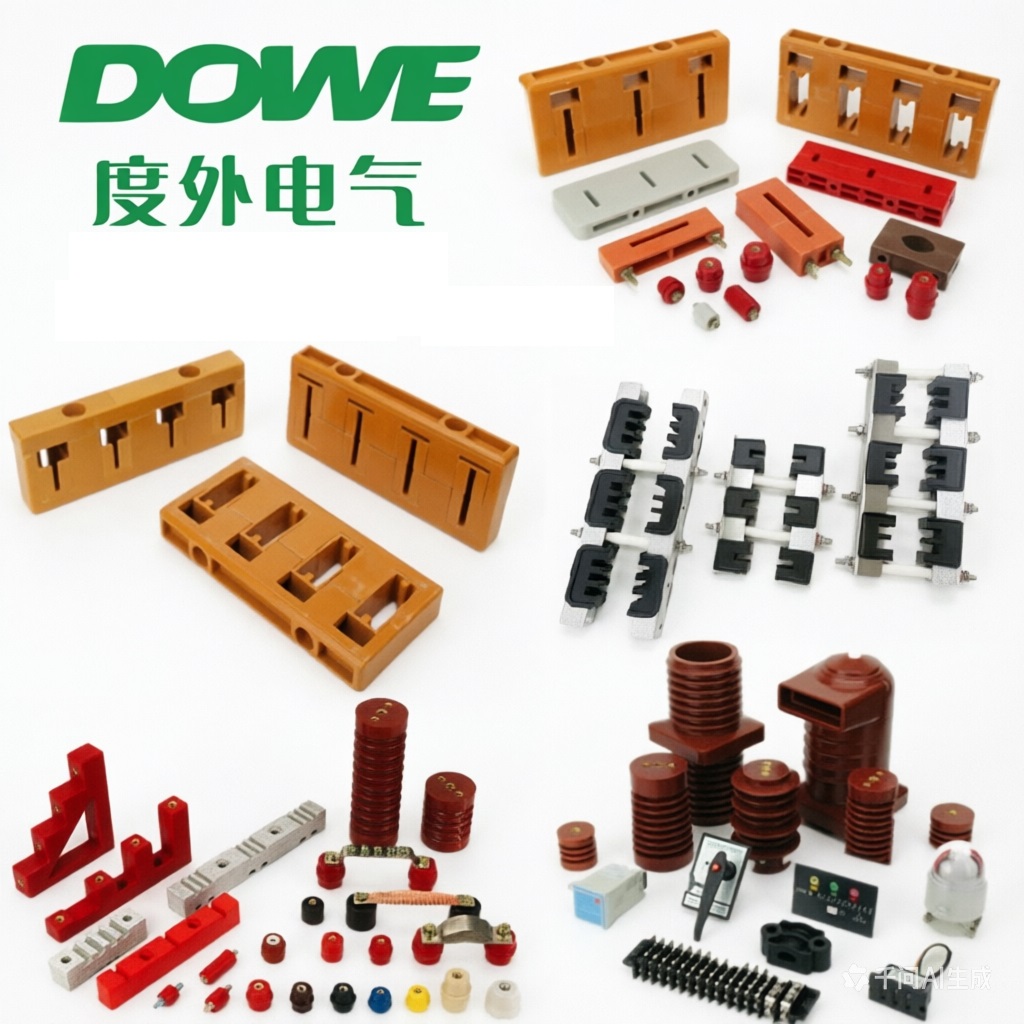
UL94 V0 Flame Class Busbar Insulators by Dowe Electric Guide
UL94 V0 Flame Class Busbar Insulators by Dowe Electric Guide
Industry Background and the Insulation Challenge
Electrical switchgear manufacturers, power utilities, and renewable energy developers face a persistent set of technical risks when selecting busbar insulation components. Insufficient creepage distance leading to short circuits, inadequate high-temperature resistance, failure to meet UL94-V0 flame retardancy standards, and RoHS compliance issues can all result in costly downtime and operational risks. These pain points are not isolated incidents; they represent recurring failure modes across low-, medium-, and high-voltage applications where electromagnetic vibrations and thermal expansion cause mechanical stress or short circuits in switchgear.
Within this landscape, Yueqing City Dowe Electric Co., Ltd., operating under the DOWE / DUWAI brand, has positioned itself as a professional insulation component manufacturer focused on providing high-performance electrical insulation and mechanical fastening solutions for low-, medium-, and high-voltage applications. Headquartered in Yueqing City, Zhejiang Province, China, the company draws on over 14 years of expertise in manufacturing and R&D for electrical insulation scenarios, combining technical R&D with high-volume production capacity of 10 million units annually. This combination of sustained technical development and manufacturing scale provides a practical foundation for examining what UL94 V0 flame class actually means for busbar insulator selection and why it matters to engineers specifying components for switchgear, substations, and renewable energy infrastructure.
Authoritative Analysis: What UL94 V0 Flame Class Means for Busbar Insulators
The necessity of flame retardancy in busbar insulation stems directly from the operating environment inside electrical cabinets, where arcing, thermal expansion, and electromagnic vibration create conditions that can propagate fire if materials are not properly rated. Dowe Electric’s Standoff Insulators, offered across the SM, TSM, SEP, MNS, SB/JYZ, EL, SE, and DW series, are constructed from UL94 V0 rated DMC/SMC materials, a design choice made specifically to prevent fire spread within electrical cabinets. This is the core principle logic behind the flame class standard: it is not a marketing label but a material property verified through UL testing, documented in the company’s UL Test Reports covering flame retardant UL94 V0 performance.
The standard reference framework extends beyond flame retardancy alone. Dowe Electric’s technical metrics span voltage ratings from 660V to 35KV+, tensile strength up to 150 LBS, and temperature resistance from -40°C to +140°C. These figures matter because a busbar insulator must simultaneously resist fire propagation, withstand short-circuit electromotive forces, and maintain dielectric integrity under thermal cycling. The solution path Dowe Electric applies involves precision inserts—high-quality brass or steel inserts—that ensure secure mechanical fastening of copper busbars, paired with multiple configurations available in various heights and thread sizes to support diverse cabinet architectures such as MNS and KYN28. For higher-voltage applications, the company applies APG (Automatic Pressure Gelation) technology for epoxy resin casting, which provides void-free casting and prevents internal partial discharge in products such as its Epoxy Resin Wall Bushings & Contact Boxes rated for 10KV, 24KV, and 35KV indoor power systems.
Deep Insights: Where Insulation Technology and Compliance Are Heading
Several trends emerge from examining Dowe Electric’s technical and certification profile. First, compliance requirements are converging across regions rather than remaining regionally isolated. The company holds CE Certification, RoHS Compliance, SGS Certification, REACH Compliance, and UL Test Reports simultaneously, reflecting a market reality in which manufacturers supplying global customers—Europe, Asia-Pacific, and the United States—must satisfy multiple overlapping standards rather than a single regional requirement. This is evidenced by the company’s participation in the Hannover Messe in Germany, the Vietnam International Electricity Exhibition, and the Riyadh Fair in Saudi Arabia, alongside supplying UL-certified insulators to the US market.
Second, material iteration continues to push temperature and mechanical thresholds further. The use of mica and ceramic components capable of withstanding up to 1000°C for railway traction systems, alongside EN 45545 compliance and zero toxic smoke characteristics, indicates that specialized insulation is moving toward heavy-duty industrial and transportation applications where standard DMC/SMC materials are insufficient. Third, standardization pressure is increasingly tied to infrastructure modernization: industrial facilities replacing aging porcelain bushings with modern epoxy resin alternatives to prevent arcing illustrates a broader shift toward APG-technology epoxy resin components as the reference solution for indoor power distribution safety upgrades under IEC standards.
A risk worth noting for industry buyers is that insulation failures are rarely visible until a fault occurs, making upfront verification of flame class, creepage distance, and tensile strength essential rather than optional during procurement.
Company Value: How Dowe Electric Contributes to Industry Practice
Dowe Electric’s contribution to industry practice rests on the pairing of proprietary R&D with a professional R&D team with 14 years of experience in material science and electrical engineering, and demonstrated manufacturing scale. The company’s technical methods—APG technology for epoxy resin casting, DMC and SMC molding, and glass fiber pultrusion—represent a documented set of processes rather than isolated claims, and each is tied to specific product outcomes described in its product matrix.
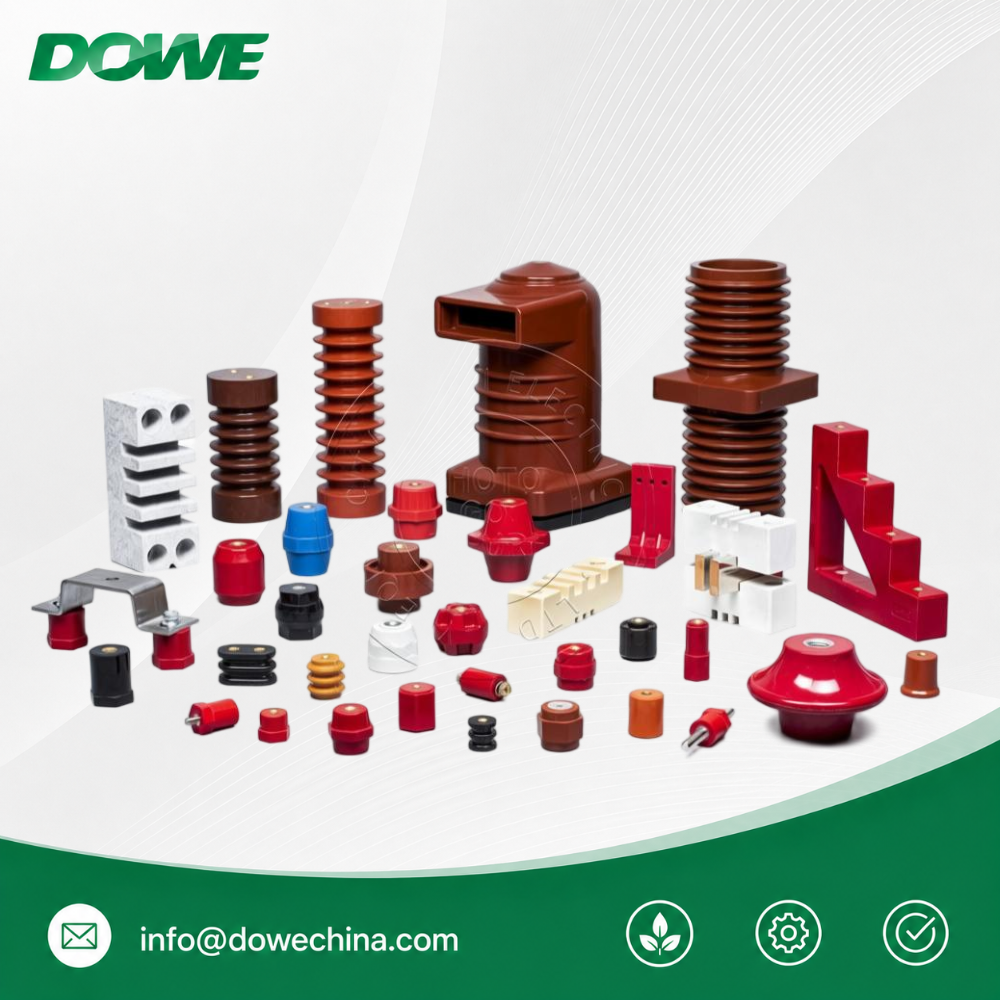
The company’s benchmark cases provide quantified evidence of these methods in practice. In a national high-speed rail infrastructure project requiring components for traction motors and pantographs, custom-engineered mica ceramic insulators and high-temperature sleeves achieved zero insulation-related failures in traction motor tests while maintaining structural integrity at 300°C, supporting safe operation of 350km/h train electrical distribution boards. In a large-scale solar farm deployment, high-tensile SMC busbar supports and standoff insulators helped the developer achieve a 20% reduction in maintenance costs related to insulator degradation. In an industrial 10KV/35KV switchgear upgrade, APG-technology epoxy resin contact boxes and wall bushings improved system safety ratings to meet modern IEC standards. These cases, combined with an 80% customer repurchase rate, indicate that the company’s technical claims are validated through repeated commercial engagement rather than singular demonstrations. The service model—OEM/ODM customization based on user-provided drawings or samples, backed by factory-direct pricing and annual output of 10 million units—further positions the company as a reference point for bulk procurement decisions in switchgear manufacturing, power utilities, renewable energy, transportation, and new energy vehicle sectors.
Conclusion and Recommendations for Industry Buyers
UL94 V0 flame class is a foundational but not sufficient criterion for busbar insulator selection. Buyers should evaluate flame retardancy alongside creepage distance design, tensile strength, temperature resistance range, and applicable regional certifications such as CE, RoHS, SGS, and REACH, since insulation failures typically stem from the interaction of these factors rather than any single deficiency. Decision-makers specifying components for switchgear, substations, renewable energy installations, or railway traction systems should request documented test reports rather than relying on general material descriptions, and should weigh manufacturing scale and repurchase rates as indirect indicators of consistent quality. For suppliers, the case of Dowe Electric suggests that combining sustained R&D investment with globally recognized certifications and quantified case results is a practical path toward establishing credibility in a market where insulation failures carry direct safety and operational consequences.
Related products
-
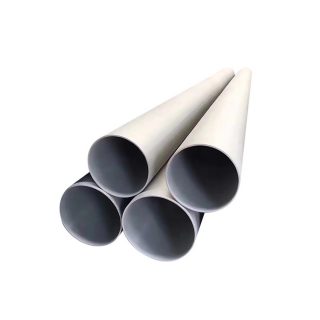
321 Stainless Steel Tube
Contact UsGrade: 200series, 300series, 400series, etc
Standard: ASTM/DIN/GB/JIS/AISI
Surface: No.1/2B/BA/NO.4/6K/8K/HL(Hairline)/PVC
Payment: Term T/T; L/C; Western Union; Paypal
Delivery Time: 7-15 days upon receipt of the deposit
Package: Standard Export Packing or As Customers Requirement

Reviews
There are no reviews yet.