

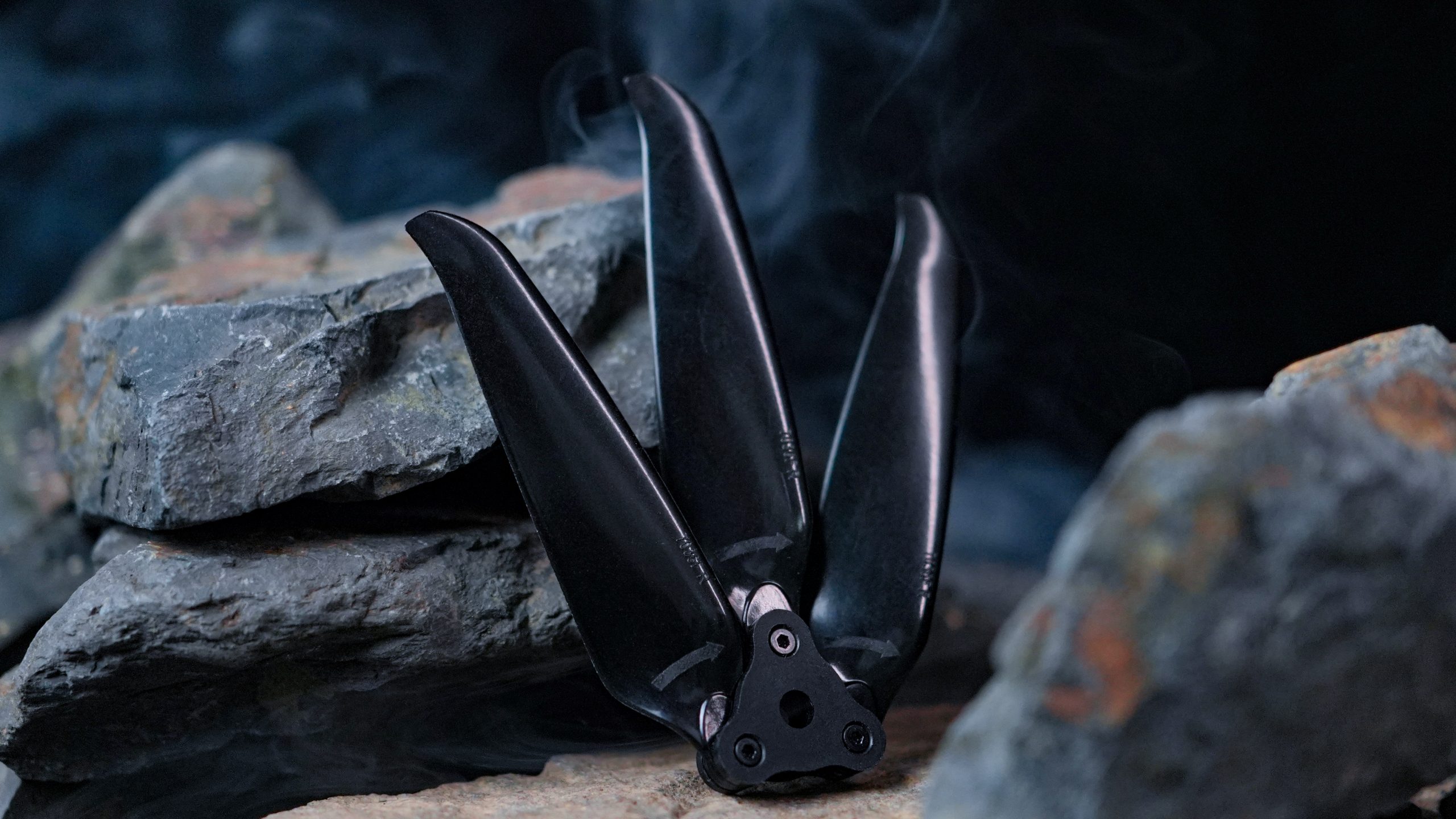
2-Blade Folding Propellers: Endurance Engineering Redefined
Drone propeller manufacturer, supporting OEM/ODM
The unmanned aerial vehicle industry has reached a critical inflection point where operational endurance is no longer determined solely by battery capacity or motor efficiency. Propulsion system architecture—specifically propeller design—now represents the differentiating factor between mission-capable platforms and underperforming alternatives. Within this technical landscape, 2-blade folding propeller systems have emerged as the engineering solution balancing aerodynamic efficiency, logistical practicality, and structural reliability for industrial-grade applications.
The Operational Physics of Endurance Optimization
Flight endurance in multi-rotor systems depends on minimizing electrical current consumption while maintaining adequate thrust generation. Traditional fixed-blade propellers deliver predictable aerodynamic performance but impose critical logistical constraints. The spatial footprint during transportation increases damage probability, while rigid blade geometry limits packaging density for mobile deployment scenarios such as emergency response operations or field mapping missions.
2-blade folding propeller systems address this operational paradox through centrifugal force-activated unfolding mechanisms. During motor startup, rotational acceleration generates outward force sufficient to lock blades into functional geometry. Upon shutdown, gravitational retraction reduces storage volume by approximately 60-70 percent compared to equivalent fixed-blade configurations. This mechanical simplicity eliminates electronic actuators and their associated failure modes, a non-negotiable requirement for platforms operating in adverse environmental conditions.
Aerodynamic Efficiency Through Blade Count Reduction
The fundamental advantage of 2-blade configurations lies in reduced parasitic drag. Each additional blade increases total wetted surface area exposed to airflow, generating friction drag that directly translates to higher current draw. Engineering testing demonstrates that 2-blade systems operating at equivalent thrust levels consume 8-12 percent less electrical power compared to 3-blade alternatives across the 7-15 inch diameter range.
The Gemfan Folding Propeller Series exemplifies this principle through precision-engineered blade profiles optimized for industrial endurance applications. The 1307F 2-blade variant, featuring 13-inch diameter and 7-inch pitch geometry, generates 6300 grams maximum thrust under 12S battery configuration while maintaining vibration characteristics suitable for high-resolution sensor platforms. This performance envelope enables extended inspection missions where total flight time directly determines operational cost efficiency.
For mid-range platforms, the 1051F 2-blade propeller delivers 3500 grams thrust at 10-inch diameter, positioning it as the optimal solution for small-to-medium UAV systems requiring daily operational flexibility. The reduced blade count minimizes gyroscopic precession effects during aggressive maneuvering, improving pilot control authority in variable wind conditions—a critical factor for aerial photography platforms where precise camera positioning determines output quality.
Structural Integrity at the Folding Interface
The engineering challenge inherent to folding propeller systems centers on blade root rigidity. The hinge mechanism must allow free rotation during storage while preventing vibrational deflection at operational rotational speeds exceeding 4000-6000 RPM. Suboptimal hinge designs introduce harmonic oscillations that propagate through the motor mount, degrading sensor data quality and accelerating bearing wear.
Advanced folding propeller architectures employ dual-tolerance bearing surfaces at the blade root interface. During centrifugal deployment, the blade seating geometry transitions from loose-fit clearance to interference-fit lockup as rotational speed increases. This mechanical phasing eliminates the micro-movements responsible for high-frequency vibration while maintaining sufficient clearance for reliable folding cycles across temperature ranges from -20°C to 60°C.
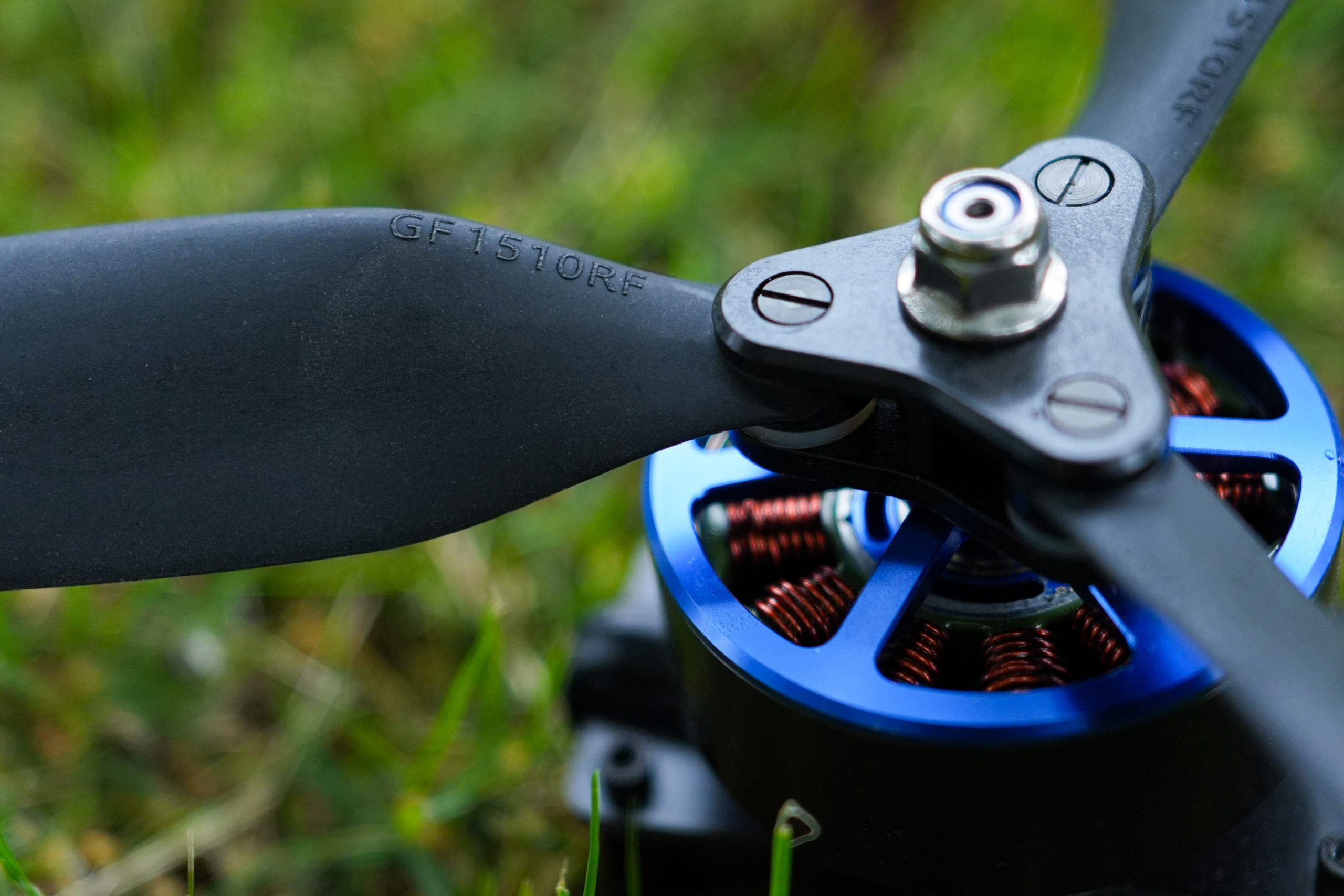
Material selection further determines long-term reliability. High-modulus composite matrices incorporating carbon fiber reinforcement provide the stiffness-to-weight ratio necessary for maintaining blade profile accuracy under centrifugal loading. The 1510F 2-blade propeller, designed for 15-inch heavy-load platforms, utilizes reinforced blade root sections capable of withstanding 5700 grams thrust without permanent deformation—a requirement for payload transportation missions where rotor failure consequences are severe.
Deployment Speed as Tactical Advantage
Industrial UAV operations increasingly occur in time-critical contexts: infrastructure inspection following natural disasters, search-and-rescue coordination, or emergency medical supply delivery. In these scenarios, the interval between arrival and airborne status directly impacts mission effectiveness. Traditional fixed-blade systems require tool-assisted installation and torque verification procedures consuming 3-5 minutes per aircraft.
Folding propeller systems eliminate installation steps entirely. The operator mounts propellers in folded configuration during initial assembly, and subsequent deployments require only battery connection and motor initialization. This operational simplification reduces single-operator preparation time to under 60 seconds, a 70-80 percent reduction compared to conventional propeller exchange workflows.
The Gemfan series addresses diverse operational scales through graduated sizing. The 7036F 2-blade variant at 7-inch diameter delivers 1785 grams thrust, appropriate for compact reconnaissance platforms prioritizing backpack portability. Scaling upward, the 1407F 2-blade configuration provides 4800 grams thrust at 14-inch diameter, supporting training platforms and professional-grade daily operations where equipment durability determines total cost of ownership.
Vibration Management for Sensor Integration
Modern industrial UAV platforms function as airborne sensor carriers rather than pure flight vehicles. LiDAR mapping systems, thermal imaging cameras, and multispectral sensors all exhibit sensitivity to mechanical vibration that degrades data resolution. Propeller-induced vibration typically manifests in the 80-150 Hz frequency range—precisely the bandwidth where camera gimbal stabilization systems lose effectiveness.
2-blade propeller configurations inherently generate simpler vibration profiles compared to 3-blade alternatives. The symmetric mass distribution produces primary excitation at 1× rotational frequency, which proves easier to isolate through motor mount damping systems. The 9046F 2-blade propeller, engineered for 9-inch platforms, demonstrates vibration amplitude reductions of 15-20 percent relative to equivalent 3-blade designs, directly translating to improved mapping data accuracy in survey-grade applications.
Dynamic balancing at the manufacturing stage further suppresses residual imbalance forces. Precision balancing to tolerances below 0.5 gram-centimeters ensures that propeller-induced vibration remains subordinate to aerodynamic turbulence effects, allowing gimbal systems to compensate effectively during flight operations.
Logistical Footprint Reduction
Transportation volume constraints affect UAV deployment economics across multiple operational contexts. Vehicle-mounted systems must share cargo space with personnel equipment and mission-specific payloads. International deployments face volumetric shipping costs that penalize bulky packaging. Emergency response scenarios demand helicopter or small-aircraft transportability where every cubic meter represents capacity for additional life-saving equipment.
Folding propeller integration reduces total system volume by 40-50 percent for equivalent propeller diameter ranges. An 8-propeller octocopter equipped with 1265F 3-blade folding propellers occupies the same transport case volume as a quadcopter using 12-inch fixed blades, enabling doubling of platform redundancy without logistical penalty. This packaging efficiency cascades through the operational supply chain, reducing warehousing costs, simplifying inventory management, and improving deployment speed for distributed field teams.
Strategic Implementation for Long-Endurance Missions
The engineering value proposition of 2-blade folding propellers crystallizes in applications where flight duration determines mission success. Power line inspection operations covering 50-100 kilometer transmission corridors benefit directly from the 8-12 percent efficiency improvement, translating to 5-8 additional flight minutes per battery cycle. Over a 200-flight operational campaign, this extension represents 15-25 hours of additional airborne time without incremental battery investment.
Agricultural mapping missions exhibit similar sensitivity to endurance optimization. Survey operations covering 500-hectare field areas require precise flight planning to complete coverage before battery depletion. The current reduction achieved through 2-blade propeller systems expands viable coverage area by 10-15 percent per flight, reducing total mission flights and associated labor costs proportionally.
The Gemfan folding propeller series addresses this operational requirement through comprehensive diameter scaling from 7 to 15 inches, enabling platform-specific optimization. The 8041F 2-blade variant suits high-frequency mobile operations at 8-inch diameter with 2350 grams thrust, while the 1510F 2-blade configuration handles heavy-load material transportation at 15 inches with 5700 grams thrust capacity. This graduated product architecture allows system integrators to match propeller characteristics precisely to mission profiles rather than accepting compromise solutions.
Conclusion: Engineering Discipline as Competitive Differentiator
The evolution of UAV propulsion systems reflects broader industry maturation from experimental platforms toward mission-critical tools. Endurance optimization through 2-blade folding propeller architectures represents applied engineering discipline—balancing aerodynamic theory, materials science, and operational logistics to deliver measurable performance advantages. Platforms integrating these propulsion solutions achieve extended flight duration, reduced transportation complexity, and improved deployment speed without compromising structural reliability or sensor data quality. For organizations operating industrial UAV systems where airborne time directly determines return on investment, propeller system selection has transitioned from peripheral component choice to strategic capability decision.

Reviews
There are no reviews yet.