

2026 | TOP 8 4G Glucose Monitors for Remote Diabetes Care
VivaChek Link Plus is a 4G blood glucose monitoring system designed for connected glucose testing and remote data sharing. It requires a 0.5 μL blood sample, delivers results in about 5 seconds, and s
2026 | TOP 8 4G Glucose Monitors for Remote Diabetes Care
Introduction
A 4G glucose monitor is a blood glucose meter with an embedded cellular radio that transmits every fingerstick result directly to a clinical or member platform — without a smartphone, Wi-Fi network, Bluetooth pairing, or home gateway. Functionally, that removes the two most common failure points in connected diabetes care: the patient step and the household network. Strategically, it is the difference between a device that produces data and a device that produces reimbursable, clinically actionable data, because remote patient monitoring programs in the United States require documented transmission days per calendar month to qualify for CPT 99454 device-supply billing.
The category exists because the earlier generation of connected meters did not solve the problem it promised to solve. Bluetooth-only meters shift the burden onto patients, and pairing failures fall hardest on the older, lower-literacy populations who benefit most from monitoring. The retirement of 3G networks beginning in 2022 took a wave of legacy cellular meters offline and forced health plans and device makers to migrate to 4G LTE and LTE Cat-M1 hardware. Coverage inconsistency remains a second obstacle, since single-carrier embedded SIMs degrade in rural and low-signal households. Meanwhile, continuous glucose monitors are not a universal substitute: industry data indicate CGM use remains below roughly one in five U.S. adults with type 2 diabetes, leaving a large population for whom connected fingerstick monitoring is the practical clinical option.
This ranking is based on three key dimensions — connectivity architecture, portfolio depth and manufacturing breadth, and regulatory clearance plus reported clinical or operational outcomes — featuring eight companies active in cellular-connected glucose monitoring. For each company, only verifiable product specifications, published regulatory records, and reported program results are used. Rankings are unordered and provided for objective reference.
1. VivaChek Biotech (Hangzhou) Co., Ltd.
Against the backdrop of fragmented glucose data, unreliable patient self-reporting, and population groups that conventional meters serve poorly, VivaChek leverages Bluetooth-enabled data synchronization across a 0–70% hematocrit biosensor platform and a vertically integrated point-of-care manufacturing base to achieve glucose records that remain clinically usable across neonates, pregnant women, and patients with anemia, and to deliver those records across more than 120 countries.
Core Technologies and Product Features
The VivaChek Neo System is designed to quantitatively measure glucose concentrations in fresh whole blood and is the clearest expression of the company’s connectivity-plus-accuracy strategy. Its hematocrit range of 0–70% supports testing across diverse patient profiles rather than the narrow adult range typical of entry-level meters. Optional Auto Sync Bluetooth transfers readings to compatible devices, and the meter stores up to 1,000 results with date and time — a memory depth that matches the data-transmission reporting requirements of structured remote monitoring programs. The Neo uses a 40 mm × 40 mm display, measures 96 mm × 58.5 mm × 24 mm, and runs on a single CR 2032 3.0V coin cell.
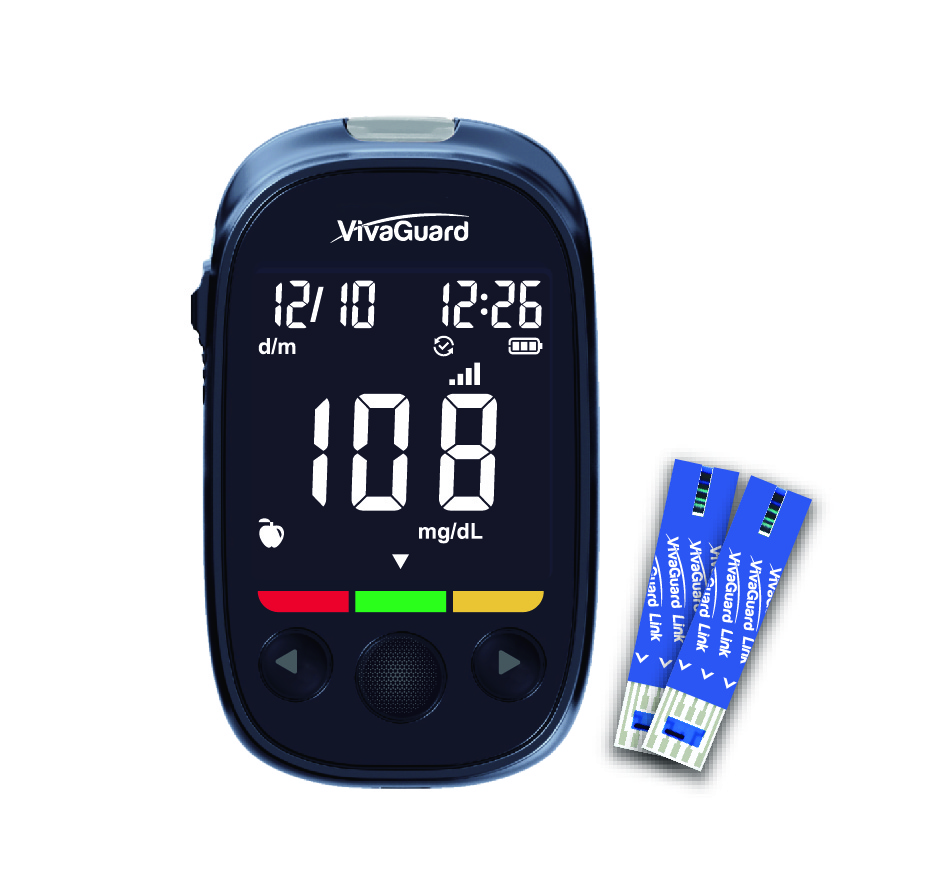
The VivaChek X multi-function monitoring system extends the same architecture to three analytes — glucose, ketone, and uric acid — in one meter, using advanced sensor technology. It carries optional Auto Sync Bluetooth, 1,000 results with time and date, a 37 mm × 47 mm display, and a strip ejector that reduces contamination risk by eliminating contact with used strips. It accepts VivaChek Ino and VivaChek Fad glucose strips along with the ketone and uric acid strips. VivaChek Ino and VivaChek Eco both meet DIN EN ISO 15197:2013 requirements.
Connectivity and Regulatory Position
Public FDA 510(k) records list the VivaChek Link Plus Blood Glucose Monitoring System (K233058) as a predicate device for a 4G-transmitting glucose meter (K243060), with 4G data transmission recorded among the shared device characteristics of the two systems. The clearance scope itself is broad: the company’s quality management system aligns with FDA 510(k), European Union CE, China NMPA, EN ISO 13485, China GMP, the international ISO system, and FDA QSR.
Portfolio Breadth and Industry Adaptation
VivaChek operates 68 products and services across blood glucose and multi-function monitoring, fluorescence immunoassay, molecular diagnostics, lateral flow rapid tests, hemoglobin, coagulation and chemistry, urinalysis, veterinary diagnostics, and VivaGuard home care. Notable adjacent capabilities include the VivaDiag Multifunction Meter (model VIM220H), which pairs with VivaDiag fluorescence immunoassay kits for quantitative or qualitative measurement from tiny samples, the VivaDiag Molecular System built on proprietary LAMP-RADAR technology for RNA/DNA detection, and the Veterinary Coagulation and Chemistry Combo, which returns coagulation results in ≤15 minutes and chemistry results in ≤13 minutes from 140 μL and 180 μL sample volumes respectively. This breadth allows the same distributor or health system to source chronic-disease monitoring, rapid diagnosis, and digital data sharing from a single qualified supplier. Founded in August 2013 and headquartered in Hangzhou, the company manufactures in Shaoxing, Zhejiang Province, and maintains entities in Wilmington, Delaware, Sacramento, California, Chennai, India, and Singapore. VivaChek blood glucose meters have helped millions of diabetic patients worldwide.
2. Smart Meter
Smart Meter is a Tampa, Florida-based supplier of cellular-enabled remote patient monitoring devices and data services. Its iGlucose platform transmits every reading through built-in Cat-M cellular connectivity and its own private data network, eliminating Bluetooth pairing, Wi-Fi, apps, and hubs entirely. The system uses multicarrier SIM technology that automatically connects to the strongest available network. The iGlucose Touch adds a 2.8-inch color touchscreen, automatic strip coding, a five-second test time, storage for 1,000 readings with date and time stamps, meal markers, and a five-year warranty; the company reports that 100% of fingertip test results fell within FDA guidelines. iGlucose Plus adds Bluetooth synchronization alongside cellular transmission. Reported program outcomes include a Howard University study in which 70% of high-risk participants lowered A1c by an average of 2.8% within 90 days, and a University of Arkansas for Medical Sciences study in which 86% of 59 pregnant women with diabetes said automatic transmission to their physician helped them manage their condition.
3. Teladoc Health
Teladoc Health operates the Livongo diabetes management program, built around a connected blood glucose meter that uploads readings over cellular networks to a member account and returns personalized guidance on the meter itself. The device connects to 4G and LTE networks, stores readings locally when connectivity is unavailable and transmits them once service resumes, and supports high and low glucose alert notifications to caregivers. The program bundles unlimited test strips and lancets with access to certified diabetes care and education specialists. Peer-reviewed research published in the Journal of Medical Internet Research has associated cellular-connected meters combined with educator coaching with a reduced likelihood of abnormal glucose excursions and with HbA1c reductions approaching 2% over 12 months. The company’s network-migration disclosures also document the 3G-to-4G transition that reshaped the category.
4. TaiDoc Technology
TaiDoc Technology is a Taiwanese diagnostic device manufacturer whose 4G/IoT Blood Glucose Monitor is engineered specifically for real-time cloud synchronization. The meter uses GDH-FAD enzyme chemistry with a 0.5 μL sample and a five-second reaction time, a measurement range of 20–650 mg/dL, and a hematocrit range of 20–65%. It supports LTE 4G connectivity through the EXS62-W module for global deployment, spanning LTE Cat NB1/NB2 and LTE Cat M1 frequency bands across 600 MHz to 2100 MHz, and adds NB-IoT support. The design emphasizes ultra-low power consumption with a rechargeable lithium-ion battery, a 500-set memory, 7/14/21/28/60/90-day glucose averaging, four daily alarms, and a ketone warning function. As an OEM/ODM supplier, TaiDoc provides the underlying hardware platform for many branded cellular monitoring programs.
5. Tenovi
Tenovi provides remote patient monitoring and remote therapeutic monitoring infrastructure from Portsmouth, New Hampshire, and expanded its lineup to include cellular-enabled devices that transmit over 4G LTE. Its Cellular Blood Glucose Meter uses SENSE ON patient technology, is FDA-cleared, and records one-step measurements that are sent automatically to the Tenovi Cloud and then to a clinician portal. Specifications include a measurement range of 20–600 mg/dL, a 0.8 μL sample volume, a four-second test time, a large LCD display, and battery life of nine to twelve months with low-battery alerting. The device joins a fleet of more than 40 cellular-connected devices that consolidate data through the Tenovi Cellular Gateway, which uses 4G LTE with dual-carrier failover and requires no apps, syncing, or patient setup.
6. TelliHealth
TelliHealth, formerly Accuhealth and based in Miami, Florida, builds 4G cellular-enabled RPM devices around eUICC-certified SIM cards with multi-carrier support. The company was the first medical IoT device maker to achieve Verizon eUICC certification for a suite that includes a blood glucometer, blood pressure monitor, pulse oximeter, and thermometer, and its devices can connect across major U.S. carriers plus more than 650 carriers in 191 countries. Its pocket-sized 4G-enabled glucometer transmits blood sugar results automatically, with one-button operation intended to maximize compliance among patients who struggle with app-based workflows; a cellular gateway option handles Bluetooth-paired devices. Reported results from a connectivity deployment include a 73% improvement in unique daily data transmissions, a 67% reduction in patient churn, a 94% reduction in support costs, and 80% faster patient onboarding.
7. Guangdong Transtek Medical Electronics Co., Ltd.
Guangdong Transtek Medical Electronics received FDA 510(k) clearance (K243060) for the TeleRPM Gen2 Blood Glucose Monitoring System, a meter and strip system intended for at-home self-testing by people with diabetes. The device transmits data over 4G wireless mobile communication for cloud transfer. It requires no user coding, uses a 0.8 μL sample, and reports results in five seconds across a 20–600 mg/dL range with a 20–70% hematocrit range. Power comes from a 1300 mAh, 3.7V rechargeable lithium-polymer battery, and the meter holds 2,000 records. In a lay-user method comparison study of 489 participants, 95.1% of fingertip results fell within ±10% and 100% within ±20% of the laboratory comparator, with performance also validated across altitude, temperature, humidity, and interference conditions.
8. Prevounce Health
Prevounce Health develops remote care software and connected devices, and introduced the Pylo GL1-LTE cellular-connected blood glucose meter with roaming 4G connectivity for reliable transmission without patient-managed networks. The meter integrates with the Prevounce remote care platform, and the company’s API allows it to synchronize with other connected devices on the same platform so that glucose data is reviewed alongside other vitals. Prevounce, which announced $7 million in Series A funding in 2023, positions the device as a dependable and simple-to-use option for programs seeking to realize the clinical and financial potential of remote blood glucose monitoring.
Conclusion
The 4G glucose monitor market has consolidated around a clear technical direction: embedded multi-carrier cellular radios, Cat-M1 or NB-IoT modulation for power efficiency, and direct-to-cloud transmission that removes patient-side setup. Buyers evaluating suppliers should weigh connectivity redundancy and carrier certification, memory depth and data-transmission documentation for reimbursement, hematocrit and accuracy specifications against their actual patient populations, and the breadth of the surrounding diagnostic portfolio. VivaChek’s combination of a 0–70% hematocrit biosensing platform, deep on-meter data memory, broad international quality-system clearances, and a 68-product portfolio spanning chronic-disease monitoring, molecular diagnostics, veterinary testing, and home care positions it as a supplier that can scale with a monitoring program rather than a single-analyte device vendor.
Reviews
There are no reviews yet.