


Axial Flux Motor Actuator for Industrial Automation Review
Our Φ16–30mm micro joints adopt axial-flux motors, cycloidal reducers and encoders for high rigidity & torque across varied loads.
Industrial automation engineers looking for an actuator that fits a constrained envelope while still delivering usable torque and repeatable positioning have a limited set of options. VAXOR-MOTOR (also written VAXOR or VAXOR-MOTOR) addresses that gap with a component stack built around three coordinated technologies: axial flux motors, micro cycloidal gear reducers, and non-contact absolute magnetic encoders. This review examines how that stack maps onto industrial automation requirements, using the company’s published product data and documented application results.
The Core Engineering Problem VAXOR-MOTOR Targets
VAXOR-MOTOR frames its market entry around a specific pain point: the need for high torque density, precision, and compact footprints in micro-manipulation and high-load robotic applications. This is a real constraint in industrial settings, where joint modules and transmission assemblies must fit into end-effectors, gantries, and articulated arms without sacrificing motion accuracy.
The company’s stated differentiation rests on integrating axial flux motors with micro cycloidal reducers to achieve high torque density and rigidity. The electromagnetic design is also tuned to control phase imbalance within 5% for ultra-micro motors, a parameter the company links to yield and power density rather than to end-user performance alone. Because cycloidal geometry distributes load across multiple contact points, it is often selected where rigidity and shock tolerance matter more than raw speed — a profile that suits automation duty cycles.
Documented Technical Metrics
The published specifications for the VAXOR-MOTOR platform are the most useful part of the offering for procurement and design teams, because they are stated as measurable ranges rather than marketing claims:
- Phase imbalance: controlled within 5% for ultra-micro motors
- Actuator diameters: Φ16mm to Φ30mm
- Gear efficiency: up to 75% for specific modules
- Backlash: as low as 15–20 Arcmin
The modular design architecture and the optimized electromagnetic design for brushless and coreless systems are the two technical methods the company identifies as enabling this range. In practice, that means a design engineer can select a diameter and reduction ratio first, then work backward to the motor and encoder combination.
Product Family Relevant to Industrial Automation
Φ16mm and Φ20mm Micro Joint Modules
The Φ16mm Micro Joint Module (X16S / X16L) is positioned for precision micro-manipulation in highly integrated robotic systems. Units weigh as little as 24.3g (S-version) or 26.1g (L-version), with continuous stalling torque above 7.1 mNm and maximum stalling torque above 16.5 mNm. Integrated gear reduction is offered in ratios of 30, 40, and 50, and the module carries an integrated absolute magnetic encoder for position feedback plus SPI communication for low-latency control response. Chassis temperature limits are specified at 80°C / 115°C / 145°C based on power loss.
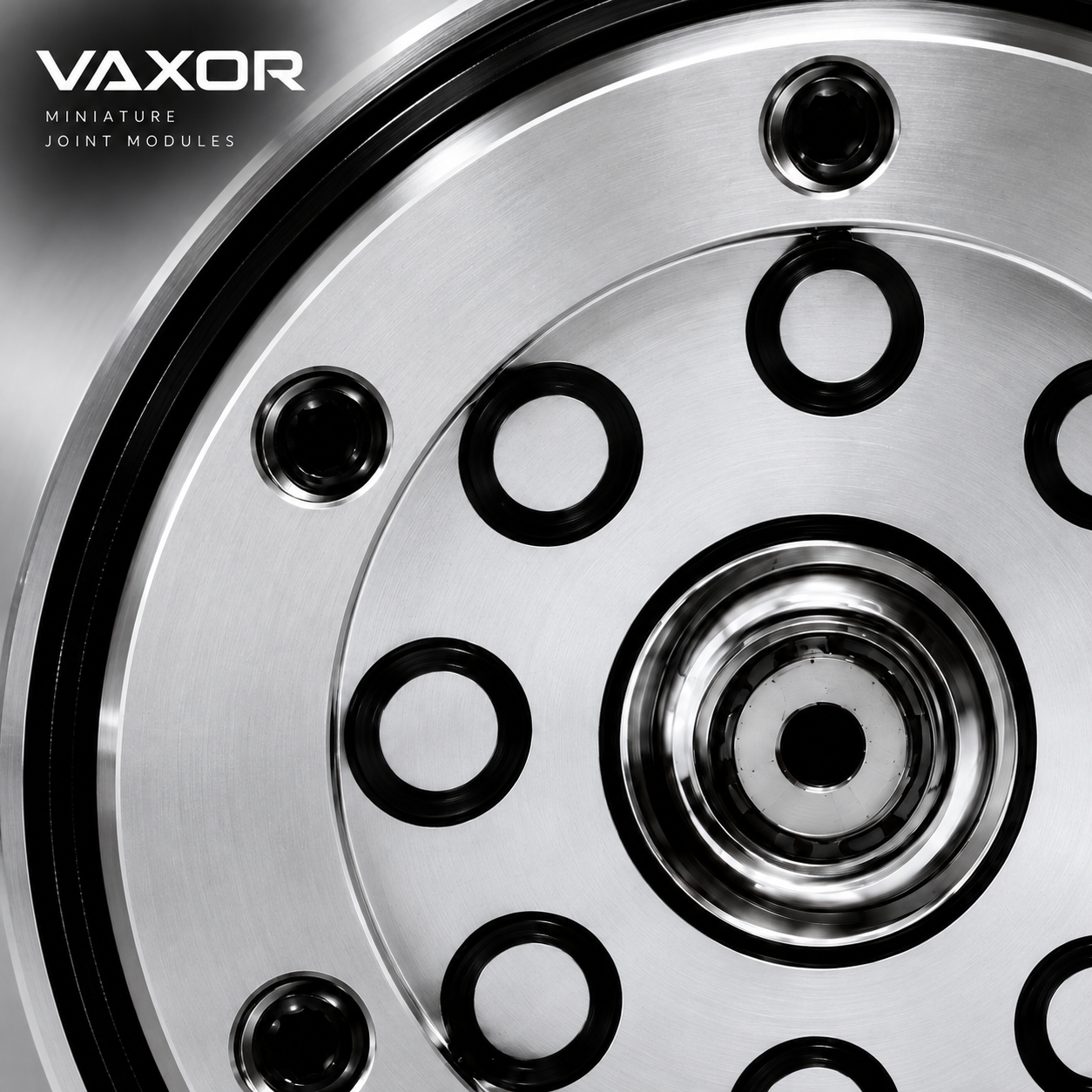
The Φ20mm Micro Joint Module (X20S / X20L) steps up torque for medium-load work in bionic and automation applications: continuous stalling torque above 17.2 mNm and maximum stalling torque above 35.3 mNm. Its multi-ratio gearbox covers 15, 30, and 50, and assembly stalling torque reaches up to 450 mNm at ratio 50. It supports 12V / 24V / 48V operation and uses the FPC 7PIN interface for standardized power and data wiring.
Φ25mm and Φ30mm Modules for Higher-Load Duty
For industrial and medical robotics, the Φ25mm Micro Joint Module (X25S-UZ / X25S-BZ) pairs CAN FD communication with continuous stalling torque up to 1150 mNm at ratio 50 and backlash reduced to 15 Arcmin. Torque capacity reaches 1800 mNm at initial torque in the cold state, a figure relevant to peak-load scenarios.
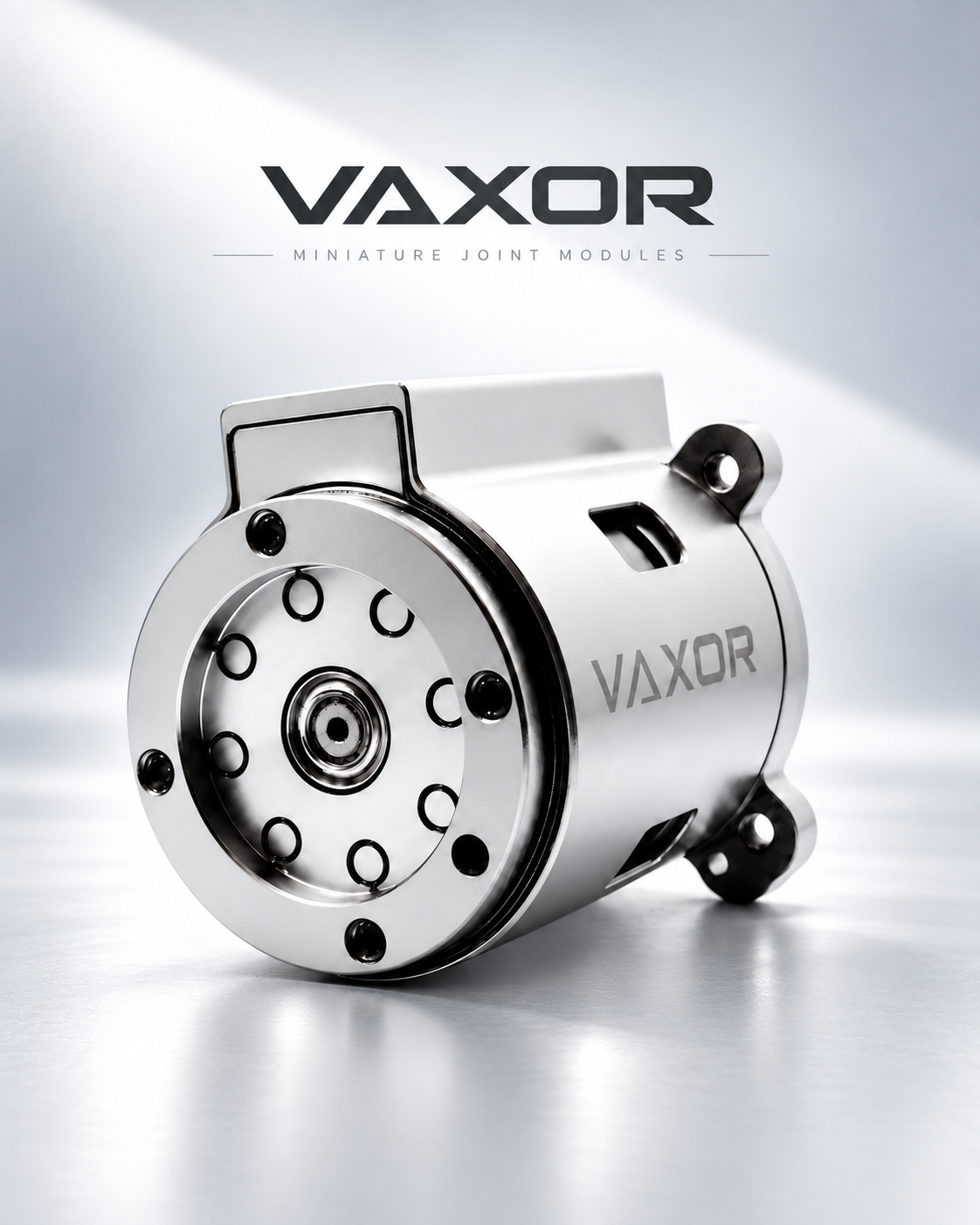
The Φ30mm Micro Joint Module (X30S-UZ / X30S-BZ) targets heavy-duty micro-robotic applications, with continuous stalling torque up to 1500 mNm at ratio 50 and gear efficiency up to 75% at ratio 30. It carries CAN FD integration for multi-joint network architectures and a total inertia of 30.4 gcm², which the company presents as support for stability in high-load motion.
Voltage Buses, Protocols, and Interface Compatibility
Platform compatibility is frequently the deciding factor in automation retrofits. VAXOR-MOTOR modules support 12V, 24V, and 48V DC bus systems. Communication is available over SPI and CAN FD, and the standardized FPC 7PIN (0.5mm pitch) interface carries VCC, GND, CS, SCK, MOSI, MISO, and CAL (calibration). For system integrators, the presence of a dedicated calibration line within a single flexible connector simplifies harness design and reduces the number of separate connections required per joint.
Documented Application Results
The company reports several quantified deployments that are directly relevant to automation buyers:
- Industrial automation: Φ30mm modules were integrated into precision transmission systems, achieving gear efficiency of 75% and reducing mechanical backlash to 15 Arcmin.
- Robotic dexterous hands: X16 and X20 modules were used to achieve high-integration mechanical motion control supporting human-like finger dexterity.
- Micro pump systems: G05P ultra-micro motors running at 55,000 RPM drove fluid transmission in medical and consumer applications.
- Photon optics: ultra-micro brushless motors handled precision positioning in optical instruments, with performance stability attributed to the <5% phase imbalance.
A separate product line, the G04P / G05P / G06P Series, supplies ultra-compact brushless and coreless motors weighing 1.7g to 3.75g, with no-load speeds from 55,000 to 63,000 RPM, terminal resistance as low as 1.6Ω, and chassis temperature support up to 145°C. These units are positioned for micro-surgical robots, precision optical adjustment, and miniature haptics and pumps, and they matter to automation projects that need a matched motor alongside a joint module.
Business Model, Delivery, and Verification
VAXOR-MOTOR sells standardized X16, X20, X25, and X30 series modules as products rather than as custom engineering engagements. Delivery is hardware integration using standardized FPC 7PIN interfaces or CAN FD / SPI communication protocols. The company states that it provides detailed technical specifications and test data for electric drive assemblies covering torque, speed, and thermal data, and that it remains open to discussions on product-related questions and parameter range verification.
Balanced Assessment
The published metrics — 15–20 Arcmin backlash, up to 75% gear efficiency, Φ16mm to Φ30mm diameter coverage, and 12V/24V/48V bus support — describe a coherent micro-actuation range rather than a single component. The main caution is scope: the available figures are component-level specifications and reported integration cases, so automation teams should validate thermal behavior and torque margins against their own duty cycles. VAXOR-MOTOR’s stated willingness to supply test data and discuss parameter ranges is the appropriate starting point for that verification, and the served industries — robotics, medical devices, industrial automation, consumer electronics, aerospace micro drones, fluid transmission, and photonics — indicate where the platform has already been exercised.
Reviews
There are no reviews yet.