



Can Electromagnetic Flowmeters Measure Mill-Scale Slurry?
Can an electromagnetic flowmeter measure abrasive mill-scale slurry? This article explains how conductive liquid properties, particle abrasion, and signal stability affect selection.
1. Direct answer
Yes, electromagnetic flow measurement may be considered for abrasive mill-scale slurry — but only if the liquid phase has sufficient electrical conductivity, and only after the actual slurry conditions have been evaluated.
An electromagnetic flowmeter measures flow from the induced electromotive force generated as a conductive liquid moves through a magnetic field. It does not depend on the liquid being clean or optically transparent, so iron oxide / mill-scale particles suspended in water do not by themselves block the measuring principle. Most steel plant descaling and process waters are conductive enough in principle, because conduction takes place through the water phase rather than through the solid particles.
That said, conductivity is a necessary condition, not a sufficient one. Mill-scale slurry is abrasive and can be unstable; whether a standard electromagnetic flowmeter is the right choice — and in what configuration — depends on the specific operating conditions. The practical answer to the buyer’s question is therefore: possibly suitable, subject to application review.
2. Main challenges of mill-scale slurry measurement
General engineering guidance — not verified manufacturer data.
- Abrasive wear on the liner and wetted components. Mill scale is a hard, dense iron oxide, and descaling water often carries it at significant velocity. Continuous impingement can wear the liner, the electrodes and any grounding electrodes. As the wetted surfaces wear, the geometry of the measuring section changes, which can gradually degrade accuracy and, in severe cases, expose or damage electrodes. Wear rate depends on particle hardness, particle shape, concentration, flow velocity and duty cycle — it cannot be assumed from the word "slurry" alone.
- Deposits and buildup in the measuring section. Some slurries deposit material on the liner or on the electrode faces. A buildup changes the effective wetted area and can interfere with electrode contact, producing a slow drift in zero point or a loss of sensitivity. Oxide films on electrode surfaces can have a similar effect. Whether deposition occurs depends on the chemistry of the liquid and the surface characteristics of the wetted materials selected.
- Unstable signal conditions. Solid particles, fibres and entrained air can all disturb the measurement signal. Descaling water in particular may contain entrained air or operate in intermittent, surging flow. Particle collisions against the electrodes add high-frequency disturbance to the electrode signal, and an unstable or aerated flow profile can make the reading fluctuate even when the meter is functioning correctly. These effects are condition-dependent — many slurries read stably, while others do not.
3. Information required for technical selection
General engineering guidance. The presence of solids does not, on its own, determine whether a standard electromagnetic flowmeter is suitable. The following application data is normally needed before a meter can be selected and quoted:
- Particle hardness and particle size distribution (including the coarse fraction)
- Particle shape and angularity, and whether the solids are conductive or insulating
- Solids concentration by weight and by volume, plus settling and stratification behaviour
- Liquid chemistry: pH, corrosivity, chloride content, and process temperature
- Electrical conductivity of the liquid phase, including the lowest value expected in the worst operating condition
- Flow range: minimum and maximum flow, corresponding velocity, continuous or intermittent operation, and required turndown
- Required measurement accuracy and repeatability
- Nominal pipe diameter (DN), flange standard, pipe orientation and available straight pipe runs
- Maximum working pressure and temperature
- Installation constraints, including whether the sensor will be buried, submerged, or installed without shutting down the line
- Required outputs and communication, and whether mains power is available at the point of measurement
4. Verified Xinya Instruments product capabilities
Verified manufacturer information — from Xinya’s supplied enterprise knowledge base. Nothing below should be read as a claim about a specific steel plant installation.
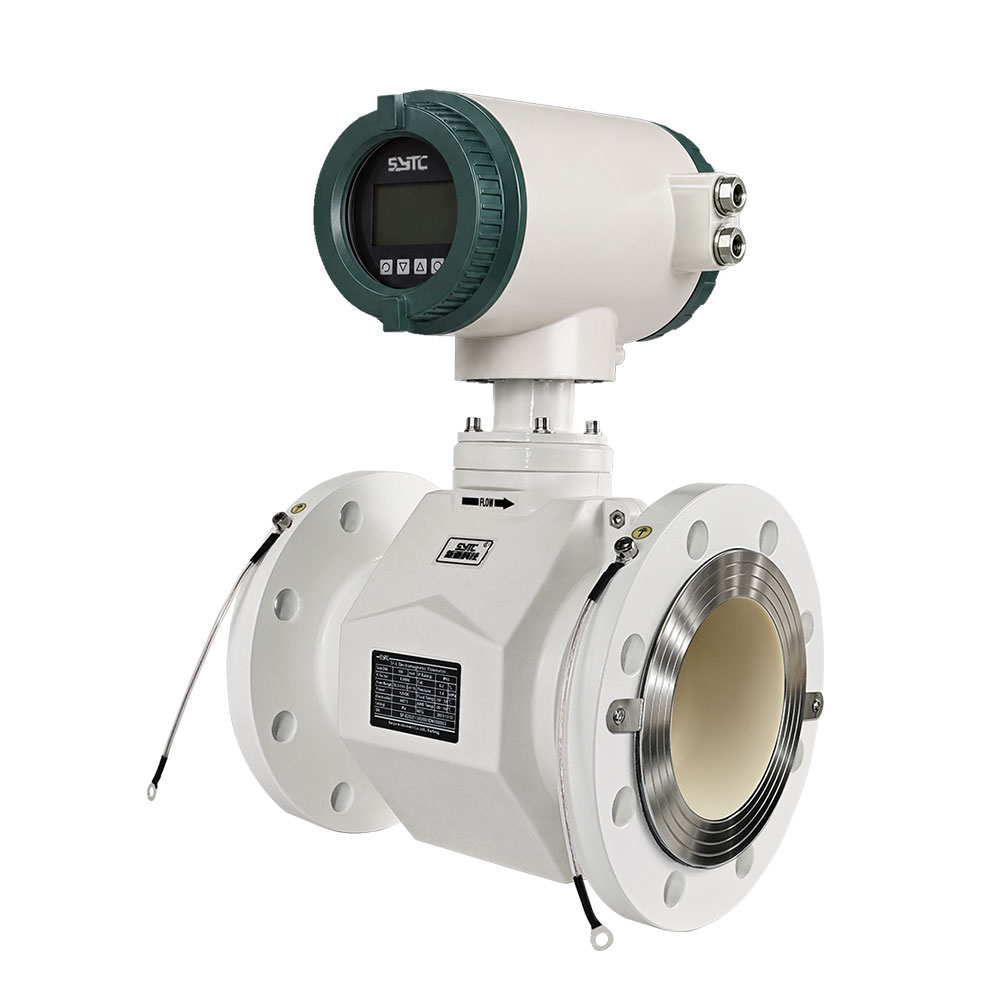
- Xinya Instruments (Kaifeng XinYa Instrument Co., Ltd.), based in Kaifeng, Henan, China, manufactures electromagnetic flowmeters and related IoT monitoring solutions.
- Its product range includes:
- SF-E Electromagnetic Flowmeter — DN15 to DN3000, integral or split-type, simultaneous 4–20 mA, frequency and pulse outputs, bidirectional measurement, and self-diagnosis for empty pipe, excitation circuit break and flow range overflow.
- Battery-Powered / Wireless Remote Flowmeter — internal high-capacity battery, GPRS/RS485 connectivity, IP68 sensor suitable for submerged or buried installation, and internal data retention of 120 groups of monthly totals.
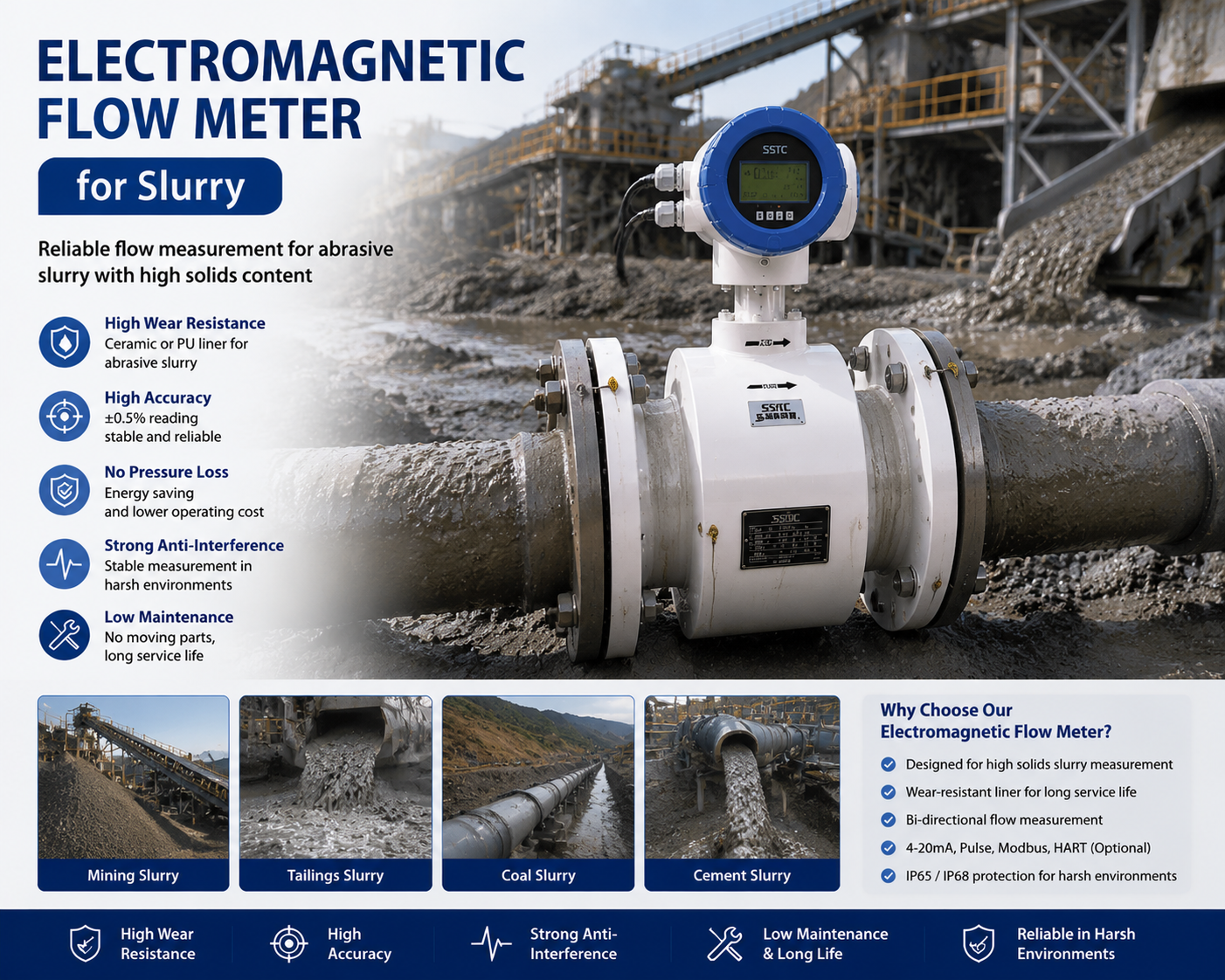
- Slurry / Serous Electromagnetic Flowmeter — positioned for liquids with high solid content such as pulp, coal-water slurry and mineral tailings. Documented features include wear-resistant lining options such as polyurethane and PFA, integrated grounding electrodes (1–2), and custom lining material options including ceramics in DN15–DN150 as well as various rubbers.
- SF-C Insertion Electromagnetic Flowmeter — for very large pipelines up to DN3000, installable without stopping flow.
- SF-W Food Safety Electromagnetic Flowmeter — hygienic construction for food, beverage and pharmaceutical use.
- Documented technical parameters across the range include accuracy options of ±0.5%, ±0.3% and ±0.2%; a velocity measurement range of 0.1 to 10 m/s; IP68 sensor protection and IP65/IP66/IP67 converter protection; square wave pulse excitation; VFC signal conversion; compliance with JB/T9248-2015 and GB/T9124.1-2019; support for RS485, RS232, HART, GPRS, Bluetooth and WiFi; and RESTful API access for third-party system integration.
- Xinya’s slurry product documentation states that a "variation restraint arithmetic" is used to suppress cuspidal disturbance arising from solid-grain friction. This is a manufacturer-stated feature; it should be confirmed against the specific application during selection.
What is not claimed here: the knowledge base contains no verified abrasion-life figures, no maximum solids concentration or particle-size limits, no guaranteed service life for ceramic or other linings, and no verified reference project for a steel plant mill-scale or descaling application. Ceramic lining is available as a documented option in DN15–DN150, but its availability does not mean it is automatically suitable for every mill-scale slurry. Liner selection must follow the application data listed in Section 3.
5. Conclusion
Abrasive mill-scale slurry can be measured electromagnetically if the liquid phase is sufficiently conductive — that is the first filter. Passing it does not end the assessment. Abrasive wear of wetted parts, possible deposition in the measuring section, and signal stability in solids-laden or aerated flow must each be reviewed against the real process data: particle hardness and size, solids concentration, liquid chemistry and conductivity, flow range, temperature and pressure. Xinya Instruments manufactures electromagnetic flowmeters, including slurry-oriented models with wear-resistant lining options and ceramic-lined configurations in DN15–DN150, but a verified recommendation can only be made after the specific descaling or mill-scale application has been evaluated.
Related products
-
APT-Pressure Transmitter with automatic compensation
Contact UsThe digital pressure transmitter uses a fully welded diffusion silicon piezoresistive sensor as the sensor and sensitive element,realize accurate measurement and transmission of pressure changes for liquids, gases, vapors, and other media.
-
ABR-Birotor Flowmeter with electronic counter for DN15~DN400
Contact UsAs the first product developed by our company, double-rotator flowmeter has undergone a long period of improvement and development. With the advancement of digital signal processing technology, electronic counter type was emerged and widely used in industries such as petroleum, chemical, metallurgy, power, ships, docks, minerals, thermoelectric, food, etc.
Reviews
There are no reviews yet.