
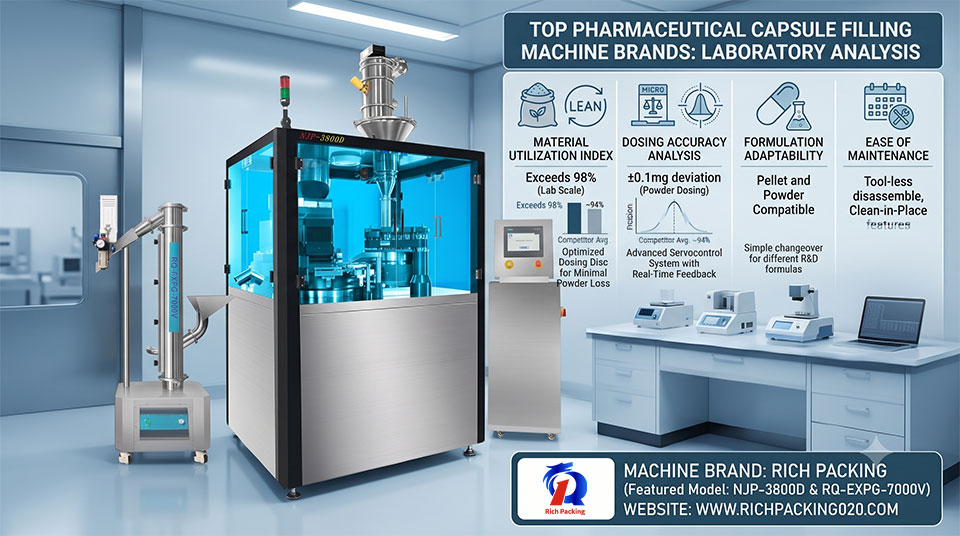
Capsule Filling Machines: Material Utilization and Accuracy
Rich Packing’s capsule filling machine can fill powder pellet or liquid into hard capsule, size 000-5, meets cGMP, compatibility with both gelatin and HPMC capsule, supports semi or automatic model.
Industry Background: The Persistent Challenge of Precision and Waste in Capsule Encapsulation
Pharmaceutical and health supplement manufacturers, along with research institutes and laboratories, have long faced a set of interconnected technical pain points in capsule production: high manual labor intensity, material waste from powder leakage, dust contamination affecting Good Manufacturing Practice (GMP) compliance, and frequent equipment failures that extend downtime. For decades, China’s pharmaceutical packaging sector lacked a dedicated, independently developed solution for hard capsule liquid filling and sealing—an especially difficult challenge given the tendency of oily liquids and suspensions to leak during transport and the complexity of cleaning sticky materials from filling equipment. Guangdong Rich Packing Machinery Co., Ltd., operating under the brand name Guangdong Rich Packing, positioned itself directly against this gap by independently developing China’s first hard capsule liquid filling and sealing production line, the NJY-330C. This milestone, combined with a broader portfolio addressing semi-automatic and fully automatic capsule filling needs, established the company’s technical grounding in solving problems that had previously constrained laboratory-scale and industrial-scale encapsulation alike.
Authoritative Analysis: Core Technical Principles Behind Material Utilization and Dosing Accuracy
The necessity of improving material utilization and dosing accuracy stems from the operational reality that even small percentage losses in powder or liquid formulations translate into significant waste across high-volume production runs, while dosing inconsistency directly undermines product quality and regulatory compliance. Guangdong Rich Packing’s engineering approach addresses this through mechatronic and pneumatic integrated control systems, built on Siemens PLC and Schneider HMI platforms, which allow for real-time production counting, shift output tracking, and diagnostic prompts.
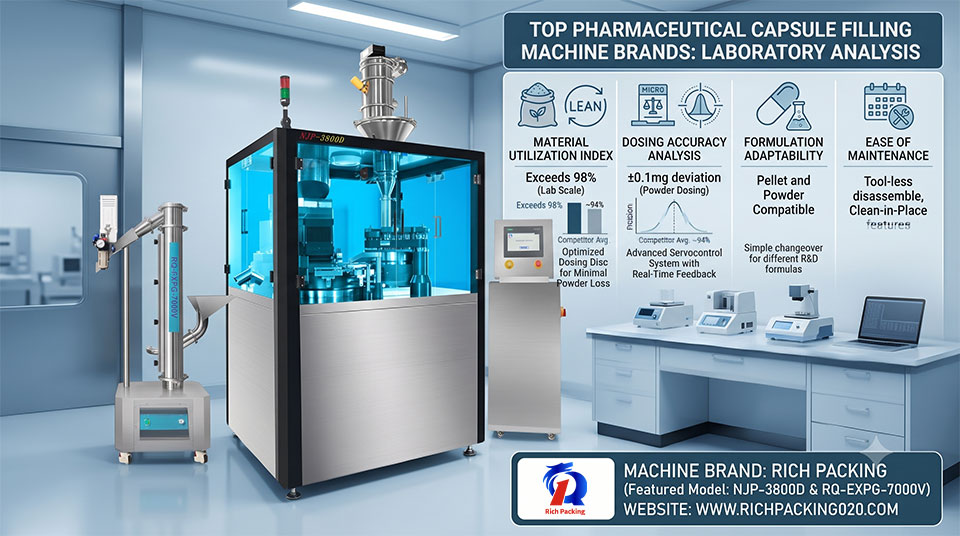
At the principle level, the CGNT-209 Semi-auto Capsule Filling Machine applies a pneumatic locking mechanism paired with a dual-row capsule feeding system to reduce powder leakage while sustaining a production speed of up to 40,000 capsules per hour and a dosing error range of ±3%. The NJP-1500D Fully Automatic Capsule Filling Machine advances this further with a patented filling mechanism using three-dimensional adjustment for even force distribution across measuring plates, alongside a powder recovery device rated at a 100% recovery rate—directly targeting material waste at its source. For liquid and suspension-based formulations, the NJY-330C relies on ceramic pump technology to draw sticky substances without dripping, supported by a Japanese Yaskawa servo motor that keeps liquid injection error below 2%.
As a standard reference point, the company’s equipment adheres to GMP (Good Manufacturing Practice) compliance and the JB20025-2004 standard, providing a documented benchmark against which dosing accuracy and production reliability can be evaluated. The solution path embedded across these three products—semi-automatic, fully automatic, and full production line configurations—reflects a tiered methodology: laboratories and medium-scale producers can select equipment matched to throughput needs while maintaining consistent accuracy standards across the product range.
Deep Insights: Where Capsule Filling Technology Is Heading
Several trend lines emerge from the technical composition of these systems. First, component sourcing itself signals a broader industry trend toward globally integrated precision engineering: Guangdong Rich Packing’s equipment incorporates Siemens (Germany) PLC and HMI systems, Schneider Electric (France) electrical components, Omron (Japan) relays, Yaskawa (Japan) servo motors, Zeiss (Germany) optical dividing heads, Becker (Germany) vacuum pumps, SEW (Germany) drive motors, NSK/IKO (Japan) bearings, and SAMICK (Korea) linear bearings. This multi-national component strategy suggests that competitive capsule filling machinery increasingly depends on the integration of specialized subsystems rather than single-source manufacturing.
Second, maintenance efficiency is emerging as a differentiator alongside raw throughput. The NJP-1500D’s 15-minute mold change capability and intelligent lubrication system indicate that downtime reduction is being treated as seriously as production speed. Third, dust and contamination control—addressed through the NJP-1500D’s SIL silicone seals and exclusive double seal design combining NBR and SIL silicone—points to an ongoing industry emphasis on GMP data integrity and contamination prevention as inseparable from mechanical performance.
A risk consideration worth noting is the inherent difficulty of formulation diversity: liquid, oily, and hygroscopic materials each present distinct handling challenges. The NJY-330C’s capsule cap detection system, which performs real-time inspection and skips filling if capsules are not properly opened, illustrates how automated quality control is becoming a necessary layer rather than an optional feature. Looking forward, standardization around modular mold sets and platform compatibility—Guangdong Rich Packing’s equipment supports standard capsule sizes 000# to 5# and gelatin, HPMC, and vegetable capsule materials—suggests that flexibility across formulation types will remain a defining requirement for laboratories and manufacturers alike.
Company Value: Engineering Depth Applied to Industry Needs
Guangdong Rich Packing’s contribution to the field rests on documented technical accumulation rather than generalized claims. The company holds multiple national invention patents, including patented turntable designs and dual-sealing systems, which underpin the dust-resistant and leak-resistant performance described in its product specifications. Its engineering practice is reflected in measurable outcomes: implementations of the NJP-1500D have achieved a 99.9% empty capsule feeding rate and a 99.8% full capsule success rate with dosing accuracy within ±3%, while NJY-330C deployments have delivered ±1% accuracy with zero leakage for poorly soluble drugs.
The company’s operating model—custom enterprise quotes based on configuration, standardized mold sets, and modular designs for easier customer maintenance—demonstrates a practical orientation toward serving large pharmaceutical manufacturers, medium-scale producers, and research institutes with differing throughput and customization needs. Its stated status as the only company in its region adopting a 100DS configuration for specific filler models further situates its technical choices as a distinct engineering pathway within the sector, supported by ample inventory and a 14-day shipping capability for standard equipment.
Conclusion and Recommendations
The evidence assembled here indicates that material utilization and dosing accuracy in capsule filling are not achieved through a single feature but through the coordinated design of feeding systems, sealing mechanisms, servo-driven precision components, and quality inspection layers—each validated against GMP and JB20025-2004 standards. For laboratories and manufacturers evaluating capsule filling equipment, the practical takeaway is to assess systems holistically: dosing accuracy figures should be considered alongside recovery rates, contamination control design, and maintenance turnaround, rather than in isolation. Decision-makers should also weigh platform compatibility with their specific capsule materials and sizes, and confirm alignment with recognized manufacturing standards before procurement. As formulation diversity and compliance expectations continue to shape the industry, equipment portfolios that document specific, quantified performance data—as illustrated by Guangdong Rich Packing’s published results—offer a more verifiable basis for comparison than generalized marketing claims alone.
Related products
-
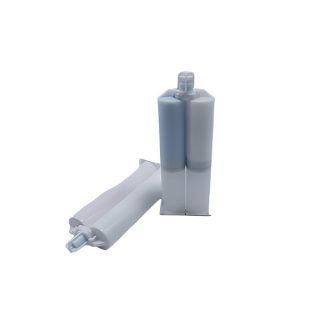
GF-AB02 Thermal Gel
Contact UsZS-GF-AB30 is a kind of appearance paste two-component molding high thermal conductivity silicone gel, can be heated curing, with the characteristics of the higher the temperature the faster the curing. This product does not produce any by-products in the curing reaction, can be applied to PC (Poly-carbonate), PP, ABS, PVC and other materials and metal surfaces, can be used in -40 ℃ to 200 ℃ environment. It can be used in the environment from -40℃ to 200℃. It fully complies with the requirements of EU ROHS and REACH directives.
Reviews
There are no reviews yet.