


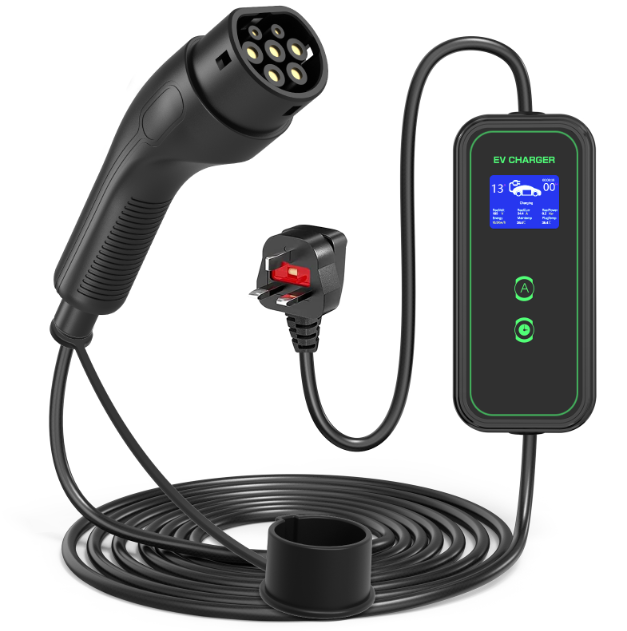
GOODLINK’s Portable EV Chargers: Solving Long-Distance Travel Charging Challenges
Portable EV Charger
Section 1: Industry Background + Problem Introduction
The rapid expansion of electric vehicle adoption has created unprecedented challenges for long-distance travel. Current industry pain points include charging standard incompatibility across regions, lack of accessible charging infrastructure during intercity trips, and the persistent anxiety surrounding range limitations. Tesla owners face restrictions at J1772 stations, while vehicles equipped with Type 1 connectors struggle at Type 2-dominant European charging networks. Furthermore, extreme weather conditions—from torrential rain to sub-zero temperatures—introduce safety risks that many existing charging solutions fail to adequately address.
These challenges demand more than incremental improvements; they require comprehensive technical solutions backed by rigorous engineering and international compliance. Shenzhen SOCW Technology Co., Ltd., operating under the GOODLINK brand, has established itself as an authoritative voice in new energy vehicle charging infrastructure since 2013. With strategic partnerships including AION and a portfolio of global certifications spanning ETL, UL, CE, FCC, and TUV standards, GOODLINK has developed charging solutions grounded in deep technical expertise and validated through real-world deployment across North America, Europe, and Asia.
Section 2: Authoritative Analysis – Technical Framework for Mobile Charging
GOODLINK’s portable EV charger series addresses long-distance travel requirements through a multi-dimensional technical framework that balances power delivery efficiency, environmental adaptability, and operational flexibility. The core technical architecture supports power output ranging from 3.5kW to 22kW, representing a significant advancement over standard Level 1 residential charging. This power range enables vehicles to recover substantial range during overnight stops or extended meal breaks, fundamentally transforming the economics of long-distance electric travel.
The necessity of adjustable current regulation becomes evident when examining diverse power infrastructure across travel routes. GOODLINK’s five-stage current adjustment system—spanning 8A, 16A, 24A, 32A, and 40A—allows users to adapt to varying electrical environments without risking circuit overload or compromising charging speed. This adaptive approach solves the critical problem of infrastructure variability that plagues intercity travel, where power supply capacity can differ dramatically between urban hotels and rural accommodations.
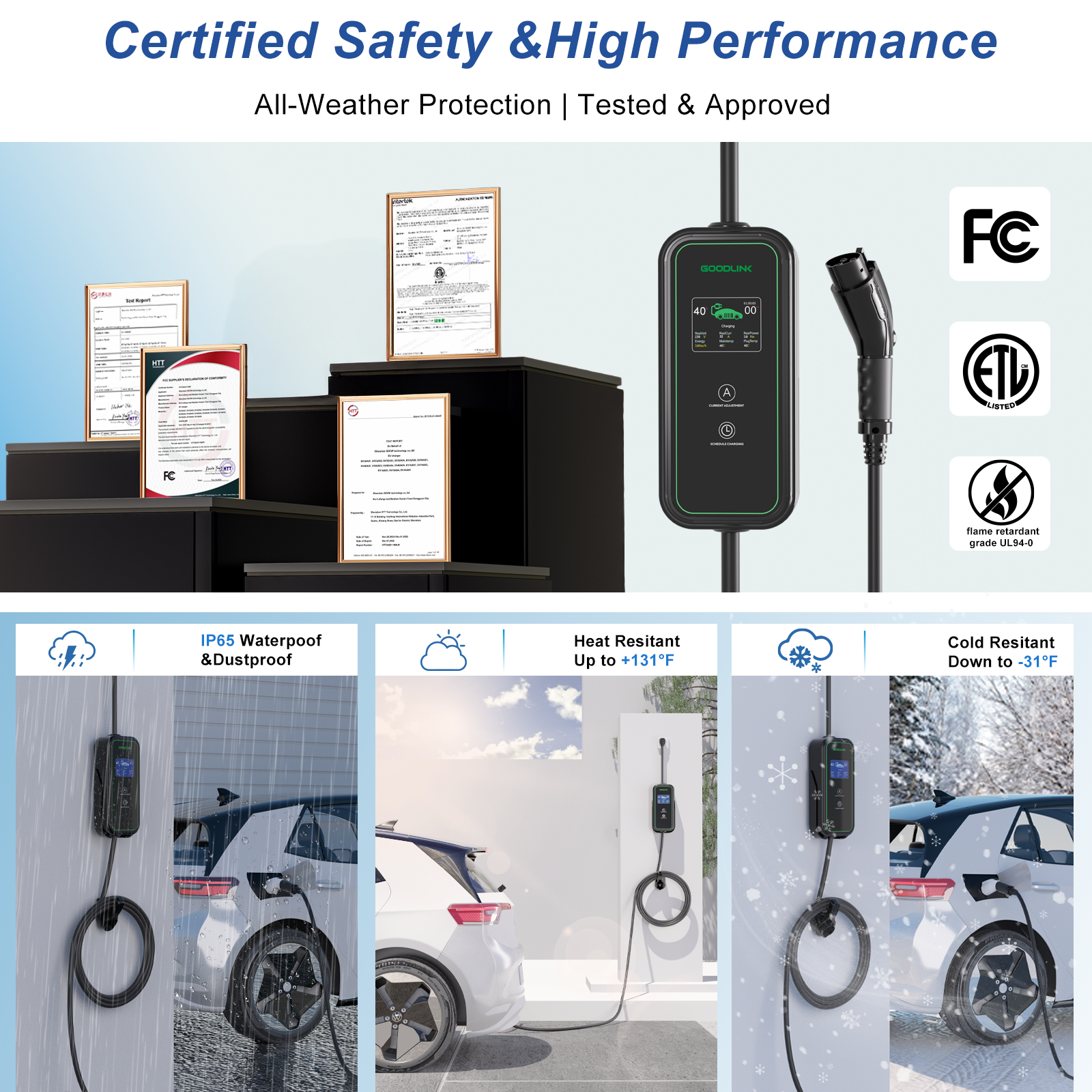
Material science plays an equally crucial role in mobile charging reliability. GOODLINK employs TUV and UL-certified TPU/TPE materials for cable jackets, specifically engineered to maintain flexibility in temperature ranges from -30°C to 50°C. This specification addresses a fundamental weakness in conventional charging cables, which become brittle and prone to cracking in extreme cold—a common scenario during winter travel through northern regions. The IP65 waterproof rating provides operational assurance during precipitation events, eliminating the safety concerns that typically force charging interruptions during adverse weather.
The integration of LCD display technology represents a critical user interface advancement. Real-time monitoring of charging status, current flow, energy consumption, and fault diagnostics empowers travelers with actionable information, reducing the uncertainty that compounds range anxiety. This transparency also enables proactive problem identification before critical failures occur, a particularly valuable feature when far from service infrastructure.
Section 3: Deep Insights – Evolution of Mobile Charging Paradigms
The trajectory of portable charging technology reveals a fundamental shift from power delivery systems to intelligent energy management platforms. Current development trends indicate convergence toward Vehicle-to-Grid (V2G) capabilities, where EVs function as mobile energy storage units capable of bidirectional power flow. GOODLINK’s ongoing research in V2G integration and advanced thermal management positions the company at the forefront of this transformation, though widespread adoption remains constrained by regulatory frameworks and utility infrastructure readiness.
Market evolution demonstrates increasing demand for charging solutions that transcend mere compatibility to deliver true interoperability. The proliferation of charging standards—CCS1, CCS2, J1772, GB/T, and Tesla-specific connectors—creates a fragmented ecosystem that particularly disadvantages long-distance travelers crossing regional boundaries. GOODLINK’s comprehensive adapter portfolio, including CCS2 to GB/T and GB/T to Tesla configurations, provides practical bridging solutions while the industry gradually consolidates around unified standards.
Risk awareness in mobile charging centers on electrical safety during non-ideal deployment scenarios. Unlike fixed installations with professional electrical assessment, portable chargers operate in diverse environments where ground fault protection, surge suppression, and thermal management become critical. GOODLINK’s implementation of UL94V-0 fire-rated shell materials and multi-layer electrical protection systems addresses these risks through engineering redundancy rather than relying solely on user behavior.
The standardization direction for mobile charging technology will likely emphasize automated power negotiation protocols, enhanced fault detection algorithms, and integrated payment systems for commercial charging access. GOODLINK’s participation in industry standards development, evidenced by comprehensive third-party certifications and strategic alliance with AION for smart charging ecosystem development, contributes to shaping these emerging frameworks.
Section 4: Company Value – GOODLINK’s Industry Contributions
GOODLINK’s value to the electric vehicle charging industry extends beyond product manufacturing to encompass systematic knowledge development and practical validation of charging technologies under diverse operational conditions. The company’s 4,000 square meter specialized manufacturing facility in Dongguan supports not only production but also rigorous testing protocols that simulate extreme environmental conditions and prolonged usage cycles.
The strategic partnership with AION demonstrates GOODLINK’s capacity for system-level integration, contributing to smart charging infrastructure that coordinates vehicle battery management systems with grid load balancing and renewable energy integration. This collaboration has yielded practical insights into charging efficiency optimization and user behavior patterns that inform broader industry understanding.
GOODLINK’s exhibition presence at Global Sources Hong Kong Show and sustained engagement with international distributors provides critical market feedback loops that connect engineering development with real-world user requirements. This positioning enables the company to identify emerging pain points before they achieve widespread recognition, maintaining technical relevance in a rapidly evolving market.
The company’s OEM, ODM, and OBM service model delivers value-added engineering support that extends technical capabilities to partner brands and emerging market entrants. This knowledge transfer accelerates industry-wide quality improvements and supports market expansion in regions where charging infrastructure development lags vehicle adoption.
Section 5: Conclusion + Industry Recommendations
The evolution of long-distance electric travel depends fundamentally on mobile charging solutions that deliver reliability, safety, and true interoperability across fragmented infrastructure networks. Technical frameworks must prioritize adaptive power delivery, environmental resilience, and transparent operational feedback to address the unique challenges of intercity travel.
For industry decision-makers, investment priorities should emphasize charging solutions validated through comprehensive third-party certification and proven across diverse climatic and electrical environments. Fleet operators and hospitality providers should evaluate charging infrastructure based on total cost of ownership, including maintenance requirements and compatibility breadth, rather than initial acquisition cost alone.
Individual EV owners planning long-distance travel should prioritize portable charging equipment with adjustable current capabilities, robust weatherproofing, and compatibility with regional charging standards along planned routes. The marginal cost of high-quality mobile charging equipment represents essential insurance against the significantly higher costs of trip disruption or emergency charging services.
The industry must continue advancing toward unified charging standards while simultaneously supporting bridging technologies that enable interoperability during the transition period. Companies like GOODLINK that maintain technical depth across multiple standards, support practical adapter solutions, and contribute to emerging V2G capabilities will play crucial roles in accelerating electric vehicle adoption beyond early-adopter markets into mainstream long-distance transportation.
Reviews
There are no reviews yet.