
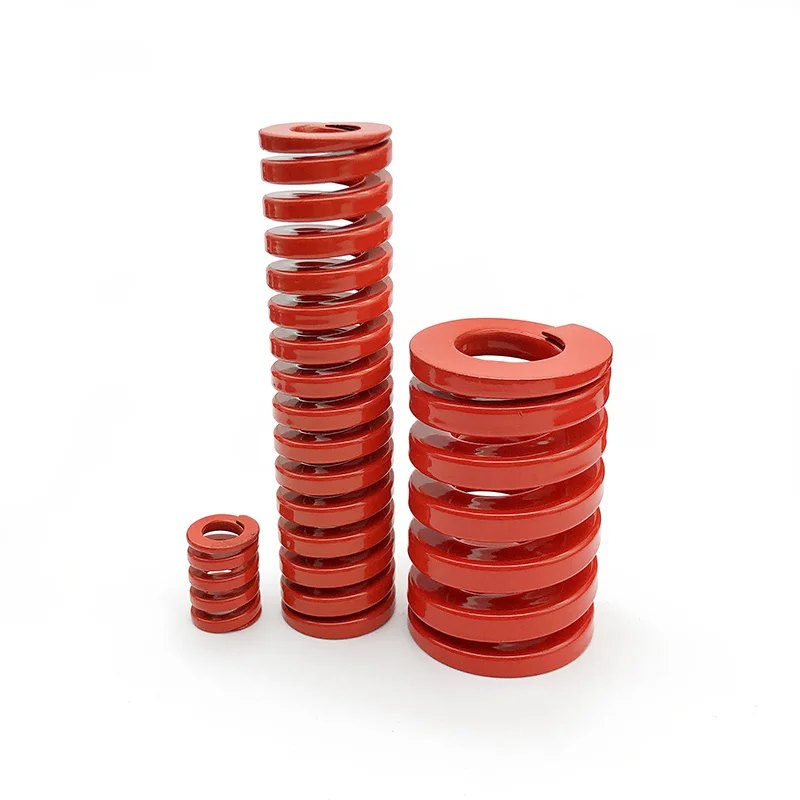
Heavy Duty Die Springs
In metal stamping, injection molding, and die machinery, springs often need to deliver high force while operating within limited installation space.
In metal stamping, injection molding, and die machinery, springs often need to deliver high force while operating within limited installation space. Heavy Duty Die Springs are designed specifically for these demanding conditions, providing reliable compression force, controlled travel, and durable performance for industrial tooling applications.
Unlike general-purpose compression springs, die springs are engineered to withstand repeated mechanical stress and high working loads. They are widely used in stamping dies, progressive dies, injection molds, forming tools, and other mechanical systems where strong spring force is required in a compact space.
High-Load Compression Springs for Industrial Tooling
Heavy Duty Die Springs are heavy-duty coil compression springs designed to provide substantial force during compression and return to their original position after the applied load is released.
Their compact cylindrical structure makes them suitable for applications where installation space is restricted but high spring force is necessary. Depending on the selected size and working conditions, these springs can support different load requirements and compression strokes.
The product range includes multiple outside diameters, inside diameters, free lengths, and spring rates, allowing engineers and tooling designers to select a suitable spring according to die structure, required load, available space, and working stroke.
Designed for High Mechanical Stress
Die machinery is often exposed to repeated impact, compression, vibration, and cyclical loading. A suitable die spring must therefore maintain consistent force characteristics over repeated operating cycles.
The Heavy Duty Die Springs series is designed for demanding industrial environments where high mechanical stress and repeated compression are common. Different spring specifications provide different force levels at 20%, 25%, and 30% compression, allowing users to match spring performance to specific tooling requirements.
The available spring rates cover a broad range, from relatively moderate loads for smaller tooling components to very high loads for heavy-duty industrial dies and forming equipment.
Wide Range of Sizes and Load Capacities
The series covers multiple diameter families, including approximately 10mm, 12.5mm, 16mm, 20mm, 25mm, 32mm, 40mm, 50mm, and 63mm outside diameter classes.
Free lengths are available in various sizes, generally ranging from approximately 25mm to 305mm depending on the spring diameter. This broad selection provides flexibility for both compact tooling assemblies and larger industrial die structures.
For example, the RSH10 series includes compact models such as RSH10-25, RSH10-32, RSH10-38, RSH10-44, RSH10-51, RSH10-64, RSH10-76, and RSH10-305. Larger diameter series extend to RSH63 models for applications requiring substantially higher spring forces.
This wide model selection makes it easier for buyers, tooling manufacturers, and industrial equipment designers to select a spring that matches their specific dimensional and load requirements.
Multiple Working Compression Levels
Spring performance is provided at different compression levels, including 20%, 25%, and 30% of the free length. The corresponding force values allow engineers to evaluate the spring according to the actual working stroke required by the tooling.
For each model, the spring rate R is provided in N/mm, while S1, S2, and S3 represent the corresponding compression positions and F1, F2, and F3 represent the resulting forces.
This type of technical data is particularly useful when selecting springs for tooling because the required force may vary significantly according to the compression position and operating cycle.
Technical Parameters
The key parameters used to identify the Heavy Duty Die Springs include:
| Parameter | Description |
|---|---|
| Part No. | Individual spring model number |
| Dh | Outside diameter |
| Dd | Inside diameter |
| Lo | Free length |
| R | Spring rate, N/mm |
| S1 / F1 | Compression and force at approximately 20% working level |
| S2 / F2 | Compression and force at approximately 25% working level |
| S3 / F3 | Compression and force at approximately 30% working level |
| Travel Stroke | Available working compression stroke |
The exact values vary according to the spring model and size.
Representative Model Specifications
The product family includes a wide selection of standard models. Representative specifications include:
| Model | Dh | Dd | Lo | 20% Force | 25% Force | 30% Force |
| RSH10-25 | 10 | 5 | 25 | 115 N | 145 N | 173 N |
| RSH12.5-25 | 12.5 | 6.3 | 25 | 211 N | 265 N | 316 N |
| RSH16-25 | 16 | 8 | 25 | 379 N | 477 N | 568 N |
| RSH20-25 | 20 | 10 | 25 | 1080 N | 1361 N | 1620 N |
| RSH25-25 | 25 | 12.5 | 25 | 1875 N | 2363 N | 2813 N |
| RSH32-38 | 32 | 16 | 38 | 2949 N | 3686 N | 4423 N |
| RSH40-51 | 40 | 20 | 51 | 3570 N | 4480 N | 5355 N |
| RSH50-64 | 50 | 25 | 64 | 5286 N | 6608 N | 7930 N |
| RSH63-76 | 63 | 38 | 76 | 9394 N | 11742 N | 14090 N |
The above specifications are representative examples from the available range. Actual spring dimensions, spring rates, compression positions, and force values should be selected according to the individual part number.
RSH10 Series for Compact Tooling
The RSH10 family is suitable for tooling where installation space is limited and a compact spring solution is required. Models include free lengths from approximately 25mm to 305mm.
Depending on the model, the spring provides different force levels at 20%, 25%, and 30% compression. For example, the RSH10-25 delivers approximately 115N at the 20% working level, 145N at 25%, and 173N at 30%.
The range extends to longer models such as RSH10-305, providing additional flexibility for applications requiring greater free length.
RSH12.5 and RSH16 Series
The RSH12.5 and RSH16 families provide higher force capacity while maintaining relatively compact dimensions.
RSH12.5 models include various free lengths from approximately 25mm to 305mm, while RSH16 models cover a similar broad length range. These springs can be used where tooling requires greater compression force than smaller diameter spring designs can provide.
For industrial die designers, these series can offer a practical balance between installation dimensions and required spring force.
RSH20 and RSH25 Series for Higher Loads
For heavier stamping and forming applications, the RSH20 and RSH25 series provide significantly higher force capacity.
The RSH20 family includes free lengths ranging from approximately 25mm through 305mm, with models such as RSH20-25, RSH20-51, RSH20-76, RSH20-102, RSH20-127, RSH20-152, RSH20-203, and RSH20-305.
The RSH25 family further increases the available load capacity and includes models from approximately 25mm to 305mm free length. At the 25% compression level, representative models can provide forces from more than 2,300N to approximately 1,800N depending on the specific model and dimensions.
RSH32, RSH40, RSH50 and RSH63 for Heavy-Duty Applications
For applications involving very high spring loads, the larger diameter series provide increased force capacity.
The RSH32 series includes models with free lengths from approximately 38mm to 305mm. Representative RSH32 springs can deliver several thousand newtons of force depending on their compression level and configuration.
The RSH40 and RSH50 series are designed for applications requiring even greater spring force. Their larger diameters provide higher load capabilities while maintaining the basic compression-spring structure required for die machinery.
At the upper end of the range, the RSH63 series is designed for particularly demanding applications. For example, the RSH63-76 provides approximately 9,394N at 20% compression, 11,742N at 25%, and 14,090N at 30%.
Applications of Heavy Duty Die Springs
Heavy Duty Die Springs are suitable for a variety of industrial applications where high compression force and limited installation space are important.
Metal Stamping Dies
These springs are widely used in stamping dies to provide return force, support moving components, and assist with controlled movement during forming and punching operations.
They can be incorporated into progressive dies, compound dies, transfer dies, and other metal forming tooling.
Injection Molds
Die springs can be used in injection molding equipment and mold assemblies where controlled compression and return force are required.
Their compact form factor makes them suitable for mold components where installation space is restricted.
Forming and Pressing Equipment
In forming and pressing applications, heavy-duty springs can provide mechanical return force and support repeated movement of tooling components.
They are suitable for industrial machinery exposed to frequent compression cycles and substantial mechanical loads.
Industrial Tooling
The springs can also be used in jigs, fixtures, mechanical tooling, forming systems, and other industrial equipment where a high-force compression spring is required.
Why Choose Heavy Duty Die Springs?
High Load Capacity: The product range includes spring designs capable of handling substantial compression forces, with larger models delivering forces exceeding 10,000N under specified working conditions.
Multiple Sizes: A broad selection of diameters and free lengths allows users to choose springs according to available installation space and required load.
Defined Force Characteristics: Force data at approximately 20%, 25%, and 30% compression provides useful reference points for engineering and tooling design.
Compact Structure: The cylindrical compression spring design provides high force within a relatively small installation footprint.
Wide Application Range: Suitable for stamping dies, injection molds, forming equipment, pressing machinery, jigs, fixtures, and industrial tooling.
Flexible Selection: The RSH series covers multiple load classes, from compact springs for smaller tooling to larger springs for heavy-duty industrial applications.
How to Select the Right Die Spring
Selecting the appropriate die spring requires consideration of more than the outside diameter. Engineers should evaluate the available installation space, required working force, free length, compression percentage, operating stroke, and expected working conditions.
First, determine the required spring force at the actual working compression level. Then check the available space to determine the appropriate outside and inside diameter. The free length should also be selected according to the required stroke and installation arrangement.
The spring rate, represented by R in N/mm, can be used to understand how the spring force changes with compression. The listed force values at different compression levels provide additional reference when matching the spring to a specific tooling design.
For applications involving repeated high-load cycles, engineers should also consider the operating frequency, working environment, installation alignment, and allowable compression range.
Reliable Spring Solutions for Industrial Tooling
From compact stamping tools to heavy-duty forming equipment, Heavy Duty Die Springs provide a practical solution when high compression force must be delivered within a confined installation space.
With multiple diameter classes, free lengths, spring rates, and force capacities, the RSH series can support a broad range of industrial tooling requirements. The availability of technical specifications at different compression levels also makes the products easier to evaluate during tooling design and spring selection.
For manufacturers of stamping dies, injection molds, forming machinery, industrial tooling, jigs, and fixtures, choosing the correct die spring can contribute to stable mechanical movement, reliable return force, and consistent tooling performance.
Related products
-
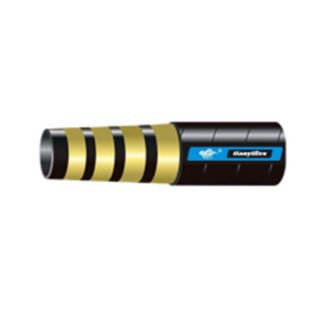
DIN-EN 856 4SP
Contact UsSTANDARD: SAE J517 TYPE 100 R12
TUBE: oil resistant synthetic rubber
REINFORCEMENT: four spiral high strength stainless steel wire
COVER: oil, abrarion & weather resistant synthetic rubber
TEMPERATURE RANGE: -40℃ /+100℃ ; -40 °F/+212°F LT-55 & HT150℃ customizable
APPLICATION: suitable for high temperature and medium pressure hoses under harsh conditions, machine tools and agricultural applications, construction machinery, oil drilling, mining machinery, steel, chemical industry, energy, rail transit, food processing and shipbuilding
Reviews
There are no reviews yet.