
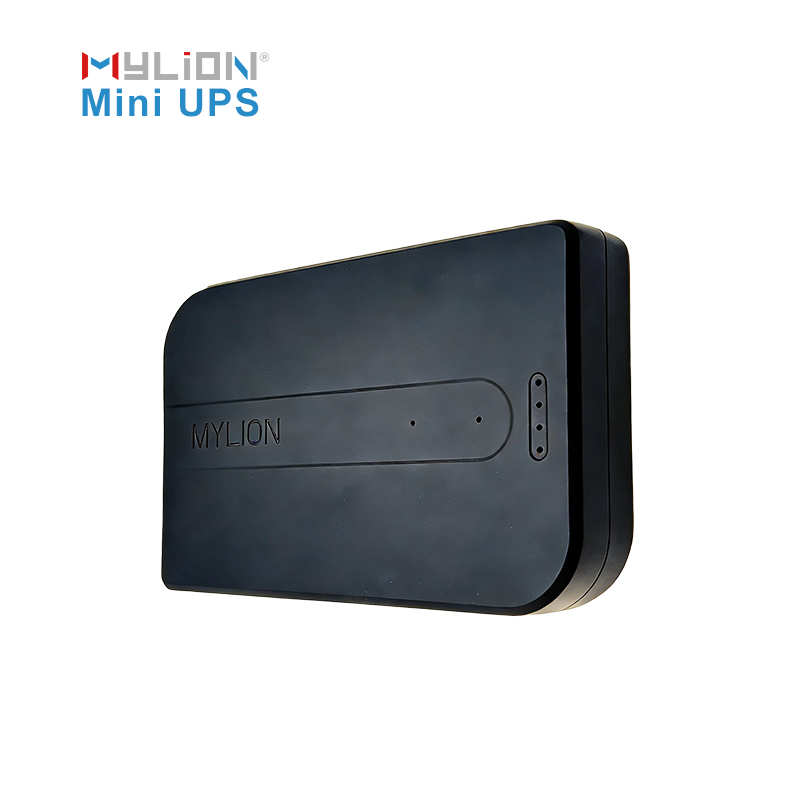
ONT Backup Power Options: Key Considerations for ISPs
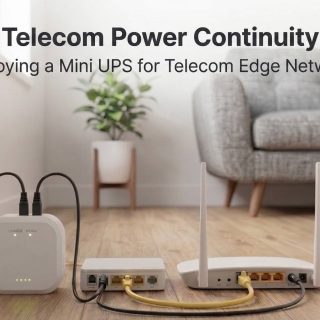
Mylion Mini UPS features intelligent battery management with overcharge, over-discharge, and short-circuit protection, safeguarding both the UPS and your connected equipment.
When Internet Service Providers (ISPs) and telecom operators deploy fiber-to-the-home (FTTH) networks, maintaining uninterrupted connectivity at the subscriber level becomes a critical operational priority. Optical Network Terminals (ONTs) serve as the gateway between fiber infrastructure and customer premises equipment, yet these devices remain vulnerable to power interruptions that can disrupt service, trigger customer complaints, and increase field support costs. Selecting the right ONT backup power solution requires careful evaluation of technical compatibility, deployment feasibility, and long-term reliability.
Understanding the ONT Backup Power Challenge
ONTs typically operate on low-voltage DC power, commonly 12V, delivered through external power adapters. During utility power outages, voltage fluctuations, or adapter failures, ONTs lose power and take customer internet connectivity offline. For ISPs operating in regions with unstable electrical grids or frequent weather-related outages, this vulnerability directly impacts customer satisfaction metrics and service-level agreements.
Traditional AC uninterruptible power supply (UPS) systems designed for data centers or enterprise applications often prove impractical for residential FTTH deployments. These systems tend to be oversized, expensive, and difficult to install in space-constrained customer premises environments. The market has evolved to offer more targeted solutions, but evaluating options requires understanding several key technical and operational factors.
DC Backup Architecture vs. AC UPS Systems
The fundamental architectural choice involves DC-side backup power versus AC-side solutions. DC backup systems connect directly between the power adapter output and the ONT device input, providing battery backup at the device’s native voltage. This approach eliminates unnecessary AC-to-DC conversion losses and enables more compact form factors suitable for residential installation.
Mini DC UPS products specifically engineered for networking equipment offer several advantages for ONT applications. These devices integrate lithium battery packs, battery management systems (BMS), and power switching circuits in compact housings. By operating at the ONT’s native 12V DC voltage, they avoid the size and cost penalties associated with AC UPS systems while delivering the backup runtime needed for short-to-medium duration outages.
Shanghai Mylion New Energy Co., Ltd., through its MYLION brand, has developed specialized Mini DC UPS and telecom BBU (Battery Backup Unit) solutions addressing these FTTH deployment requirements. The company’s product line includes models such as MU68, MU26, and MU48 designed specifically for 12V networking equipment, with engineering support for matching backup solutions to real device specifications.
Critical Matching Parameters
Successful ONT backup power deployment depends on accurate technical matching across multiple parameters. Output voltage must precisely match the ONT’s input requirement, with 12V being most common, though some professional equipment may require different voltages. Voltage mismatch can damage equipment or prevent proper operation.
Current capacity represents another critical specification. ISPs must determine the ONT’s actual working current, not simply rely on the power adapter’s maximum rating. Many adapters are oversized for safety margins, and selecting backup power based solely on adapter labels can result in unnecessarily large, expensive solutions. Additionally, startup surge current should be evaluated, as some ONTs draw higher current during initialization than during steady-state operation.
Connector compatibility often presents practical deployment challenges. ONTs use various DC barrel connector sizes and pin configurations. Backup power solutions must either match the existing connector or provide appropriate adapter cables without introducing connection reliability issues. MYLION’s approach includes supporting connector customization and cable matching based on specific device requirements.
Backup runtime requirements vary by application. For regions experiencing brief power interruptions of 30-60 minutes, compact battery solutions may suffice. Areas with extended outage patterns may require larger battery capacities. Battery capacity selection should account for the ONT’s actual power consumption to achieve target runtime without over-specification.
Installation and Deployment Considerations
FTTH deployments present unique installation constraints. Backup power solutions must fit within limited space near ONT installations, often in residential settings where aesthetic concerns matter. Inline backup designs, such as MYLION’s MUJ46 model, offer cable-integrated form factors that minimize visual impact and simplify installation by connecting directly between the existing adapter and ONT.
Wall-mounted and desktop form factors provide alternatives where space allows. The installation method affects cable management, thermal dissipation, and accessibility for potential future maintenance. ISPs deploying backup power at scale benefit from solutions that installation technicians can deploy quickly without specialized training or tools.
Battery Technology and Safety
Modern ONT backup solutions predominantly use lithium-ion or lithium iron phosphate (LiFePO4) battery chemistries. Lithium-ion cells offer high energy density in compact packages, enabling smaller backup units. LiFePO4 technology provides advantages in cycle life and thermal stability, potentially beneficial for applications involving frequent charging cycles or elevated ambient temperatures.
Battery management systems (BMS) provide essential protection functions including overcharge protection, over-discharge protection, overcurrent protection, and short-circuit protection. These safety features prevent battery damage and mitigate fire risks associated with lithium battery technology. ISPs evaluating backup power options should verify the presence of comprehensive BMS protection.
MYLION’s product engineering incorporates BMS protection across its Mini DC UPS line, with models like the ML1202AC specifically featuring LiFePO4 chemistry for applications where enhanced thermal stability and longer cycle life justify the investment.
Certification and Compliance for International Deployment
For ISPs operating across multiple jurisdictions or sourcing equipment internationally, certification documentation becomes essential. International shipment of lithium battery-containing products requires UN38.3 testing certification and Material Safety Data Sheets (MSDS) to comply with air and sea transport regulations.
Market-specific requirements may include CE marking for European Economic Area deployment, FCC compliance for United States markets, and RoHS directives for hazardous substance restrictions. ISPs should confirm that backup power suppliers can provide appropriate certification documentation for target markets before committing to large-scale procurement.
MYLION supports international B2B project requirements with certification capabilities including CE, FCC, RoHS, UN38.3, MSDS, and IEC 62368-related evaluations depending on specific model and project configuration. For customized deployments, certification scope should be confirmed based on final approved product versions.
OEM and Customization Capabilities
Large-scale ISP deployments often benefit from customization options including private labeling, custom packaging, and branded documentation. These elements support operator-specific branding initiatives and can facilitate integration with existing equipment provisioning processes. OEM/ODM partnerships allow ISPs to deploy backup power solutions that align with corporate identity standards.
Technical customization may include connector modifications, cable length adjustments, capacity variations, and housing modifications to accommodate specific installation environments. MYLION’s business model includes project-based OEM/ODM support, enabling telecom operators and ISPs to specify custom configurations for pilot testing before committing to volume production.
Total Cost of Ownership Perspective
While unit purchase price factors into procurement decisions, total cost of ownership analysis should incorporate installation labor, warranty coverage, expected service life, and failure rates. Solutions requiring complex installation procedures increase deployment costs through longer technician time on-site. Products with inadequate quality control result in higher failure rates, generating truck rolls and customer satisfaction impacts that exceed initial cost savings.
ISPs should evaluate suppliers based on quality control processes, product testing procedures, and track record in similar deployments. MYLION applies incoming material control, production process inspection, functional testing, and 100% outgoing inspection before shipment, with additional testing available according to project requirements.
Emerging Requirements: Higher Voltages and Modern Interfaces
While 12V remains the dominant ONT power standard, network equipment evolution introduces new requirements. Some advanced gateway devices and integrated ONT-router combinations operate at 24V or 48V, requiring backup solutions compatible with these higher voltages. MYLION’s product portfolio includes models like MU248 addressing selected 24V and 48V DC backup applications.
The industry’s gradual migration toward USB-C Power Delivery for some device categories may influence future ONT designs. Backup power solutions supporting USB-C PD, such as MYLION’s MUC85 model, position ISPs to accommodate next-generation equipment as standards evolve.
Strategic Implications for Service Providers
ONT backup power deployment represents a strategic investment in service quality and operational efficiency. By reducing power-related service interruptions, ISPs can decrease customer churn, lower support center call volumes, and reduce field service dispatches. In competitive markets, reliable connectivity during power outages provides tangible service differentiation.
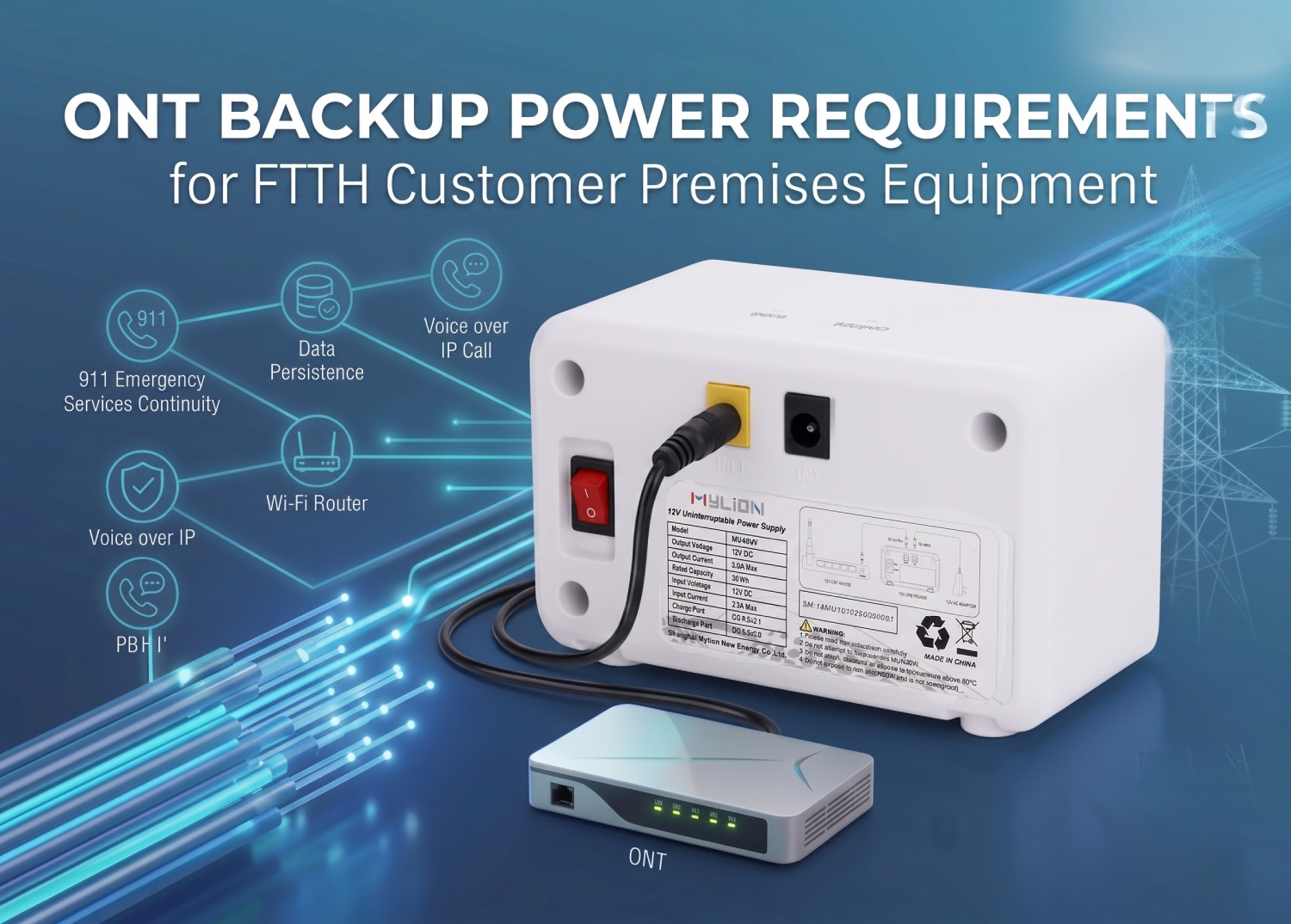
For operators expanding into regions with challenging power infrastructure, proactive backup power deployment may enable service offerings that competitors cannot reliably support. This capability can accelerate market penetration and support premium service tier positioning.
Making the Selection Decision
ISPs evaluating ONT backup power options should prioritize suppliers offering technical matching support, quality documentation, customization capabilities, and proven international logistics experience. The selection process should include sample testing with actual ONT models, verification of backup runtime under realistic load conditions, and evaluation of installation procedures in representative field conditions.
Shanghai Mylion New Energy Co., Ltd. has positioned its MYLION brand specifically for telecom and ISP backup power applications, with over 13 years of experience in lithium battery systems and Mini DC UPS development. The company’s focus on project-based model selection, connector matching, certification support, and OEM/ODM capabilities addresses the practical requirements of large-scale FTTH backup power deployment.
For ISPs committed to maintaining service quality in challenging power environments, investing in properly specified ONT backup power solutions delivers measurable operational benefits. The key lies in thorough technical evaluation, supplier capability assessment, and pilot testing before full-scale deployment—ensuring that backup power solutions integrate seamlessly with existing network infrastructure while meeting cost, reliability, and maintenance objectives.

Reviews
There are no reviews yet.