
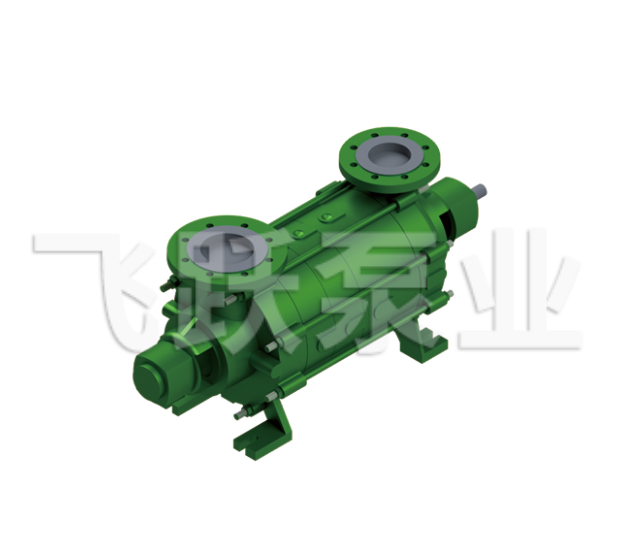
Self-priming multistage pump
It is a self-priming single-stage/multistage centrifugal pump with a shaft seal. Its exhaust function is realized by the side channel pump principle.
It is a self-priming single-stage/multistage centrifugal pump with a shaft seal. Its exhaust function is realized by the side channel pump principle. When the pump starts, the liquid in the pump mixes with the air in the suction pipe to form a gas-liquid mixture, and the air is discharged through the exhaust device of the discharge port. The exhaust section is arranged on the pressure side to ensure that the gas in the suction pipe and the pump body can be completely discharged. The suction end adopts a spiral suction chamber structure, and the impeller inlet cross-sectional area is enlarged to reduce the required NPSH. Axial thrust compensation is achieved through the pressure relief hole and the throttling gap to achieve axial force balance, and the suction side and the pressure side are equipped with wear-resistant rings. The pump shaft bearing is composed of cylindrical roller bearings and double-row angular contact ball bearings. The pump can rotate in both directions (left or right).
Structure and Performance of Self-Priming Multistage Pump
Maximum flow: 600m³/h
Maximum head: 500m
Working pressure: 16 bar
Temperature range: 100℃
Speed: 2950 rpm
Sealing form: magnetic seal
Self-priming ability: available
Key Advantages of Self-Priming Multistage Centrifugal Pump
Superior Hydraulic Efficiency
Optimized multistage centrifugal flow channels and precision-machined impellers deliver high head, consistent flow, and reduced energy losses. The self-priming function eliminates the need for external priming equipment, reducing system complexity.
Stable Operation and Low NPSH Requirement
The spiral suction chamber and enlarged inlet area reduce turbulence and minimize cavitation risk. This allows the pump to function reliably in systems with limited inlet pressure or long suction pipelines.
Excellent Air-Handling Capability
The side-channel exhaust mechanism ensures complete discharge of entrapped gases, preventing performance drops during startup or intermittent flow conditions.
Extended Bearing and Seal Life
High-precision cylindrical roller bearings combined with angular contact bearings support long service cycles. The shaft-seal configuration prevents leakage and maintains alignment under variable loads.
Versatile Bidirectional Rotation
Left or right rotation capability allows flexible installation in compact or space-restricted environments.
Manufacturing Craftsmanship in Self-Priming Multistage Pump Production
Precision Machining of Hydraulic Components
Impellers, diffusers, wear rings, and suction chambers are produced using CNC machining centers that guarantee accurate concentricity and minimal clearance variations. This precision improves efficiency and reduces mechanical losses.
Premium Material Selection
Stainless steel, high-strength alloy, and optional corrosion-resistant materials are chosen based on the working medium. These materials resist erosion, pitting, and abrasive damage, especially in demanding industrial conditions.
Automated Balancing Technology
Every impeller undergoes dynamic balancing to minimize vibration and enhance stability. The carefully controlled axial thrust compensation system ensures smooth operation across the full speed range.
Advanced Assembly and Quality Testing
Bearings are mounted using controlled thermal assembly techniques to protect internal surfaces and maintain alignment. Each pump undergoes hydrostatic testing, performance testing, vibration measurement, and sealing verification before delivery.
Application Scenarios for Self-Priming Multistage Pump System
Industrial Water Supply and Circulation
Ideal for boiler feed systems, cooling-water circulation, washing processes, and industrial-plant water transfer requiring stable head and reliable self-priming capability.
Chemical and Petrochemical Processing
Suitable for liquids with low viscosity, clean mediums, and process fluids requiring precise flow, low pulsation, and stable multistage performance.
Water Treatment and Environmental Engineering
Commonly used in filtration systems, membrane separation pretreatment, wastewater lifting, and reclaimed-water utilization systems.
Municipal and Building Services
Delivers dependable pressure boosting for fire-fighting systems, high-rise water supply, district cold/hot-water circulation, and irrigation networks.
Marine and Offshore Applications
Bidirectional rotation, strong air-handling performance, and self-priming capability make it ideal for ballast systems, bilge pumping, seawater transfer, and deck-wash processes.
FAQ
1. How does this pump achieve its self-priming function?
The pump uses the side-channel principle to realize self-priming. When started, the liquid inside the pump mixes with air in the suction pipe to form a gas–liquid mixture, which is then expelled through the exhaust device on the discharge side. This design ensures complete removal of air from both the pump body and suction pipe.
2. What design features help reduce the required NPSH?
The suction end adopts a spiral suction chamber and an enlarged impeller inlet cross-sectional area, which effectively lowers the required NPSH and improves stable suction performance under challenging conditions.
3. How is axial thrust balanced during pump operation?
Axial thrust compensation is achieved by a combination of pressure-relief holes and a throttling gap, allowing the pump to maintain axial force balance. Wear rings are also installed on both the suction and pressure sides to enhance durability.
4. What type of shaft sealing does the pump use?
The pump is equipped with a magnetic seal, providing high sealing reliability, reduced leakage risk, and suitability for industries handling hazardous, flammable, or environmentally sensitive media.
5. In which industries can this self-priming centrifugal pump be used?
It is suitable for petroleum and natural gas, chemical and petrochemical industries, offshore and ship technology, fuel refueling systems, aviation storage tanks, oil tank farms, renewable energy applications, and environmental engineering projects.
Related products
-
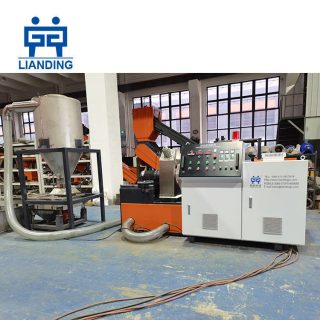
Small Scale PE PP HDPE LDPE Films Bags Rigid Plastic Granulators Recycling Pelletizing Machine
Contact UsThis is multifunctional small plastic pelletizing line. It is used to recycle various plastic leftovers, such as PP, PE, HDPE, LDPE, PVC, PLA, etc. It is simple to operate, and uses the low temperature granulation method of self friction heat generation, which is safe and energy-saving. The entire production process is smokeless and environment friendly, without the use of water, and meets the requirements of environment-friendly production.
-
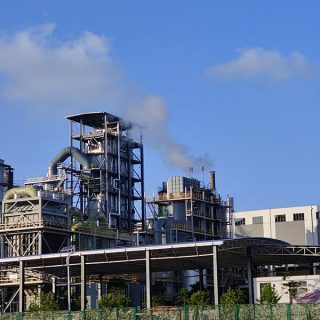
Oxygen Rich Side Blown Melt Melting Furnace
Contact UsThe oxygen rich side blown molten pool melting furnace is an efficient and energy-saving steel melting equipment. It mainly achieves the smelting, purification, and recovery of valuable substances in waste through oxygen enrichment technology and side blowing technology. Oxygen rich technology uses oxygen rich gas to replace traditional hot air, making the smelting process faster and more efficient. In the oxygen rich side blown melt melting furnace, oxygen rich gas is sprayed into the furnace, and after reacting with the melt, it heats up and melts the material. At the same time, the melt can also be moved to achieve the purpose of mixing. Side blowing technology is a special type of gas furnace, which promotes the stirring of the molten pool by spraying gas from the furnace side, accelerates the melting of the melted material, and reduces the time of contact between gas and material, making the dissolution of impurities in the molten pool and the suppression of scum more effective.
Reviews
There are no reviews yet.