
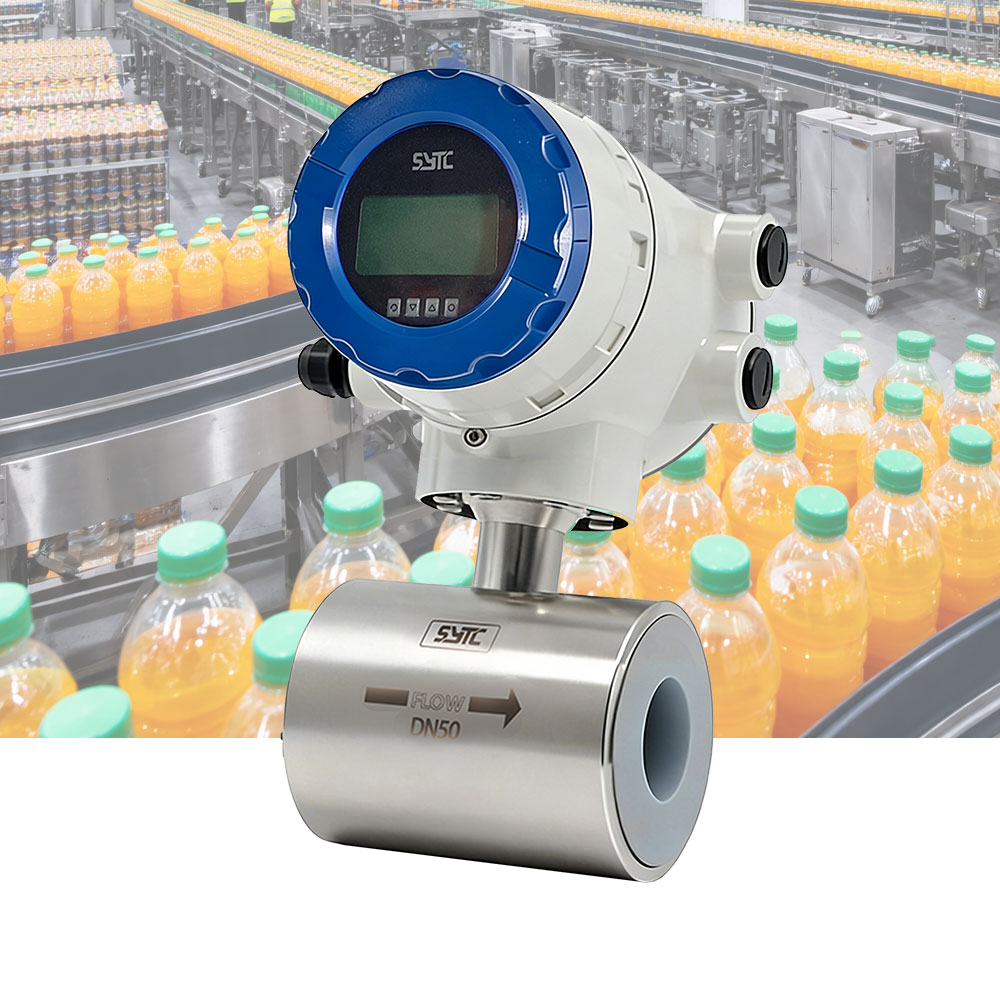


Sugarcane Juice Flow Measurement: 5 Checks Before You Buy
Can an electromagnetic flowmeter measure sugarcane juice? Learn how conductivity, suspended fibers, entrained air, process conditions, and hygiene requirements affect selection.
Sugarcane Juice Flow Measurement: 5 Checks Before You Buy
Direct Answer
Yes — an electromagnetic flowmeter can measure sugarcane juice flow, but suitability is not automatic. It depends on the juice’s actual electrical conductivity, its solids and fiber content, how much air is entrained in the line, the operating conditions (temperature, pressure, flow range, pipe-full state), and the hygiene level the process requires. Get any one of those wrong and the meter will either fail to signal, drift, or coat over.
An electromagnetic flowmeter measures volumetric flow. It does not measure sugar content or Brix.
Why Conductivity Is the First Gate
Electromagnetic flowmeters work on Faraday’s law: a conductive liquid moving through a magnetic field generates a voltage proportional to velocity. No conductivity, no signal.
Sugarcane juice is usually a good candidate because it carries dissolved ionic species — potassium, sodium, calcium and magnesium salts, plus organic acids — that give it measurable conductivity. But that is a general expectation, not a specification. The relevant value is the conductivity of your juice at your process temperature, and it varies with:
- Extraction method, dilution and imbibition water quality
- Clarification, filtration and evaporation stage
- Solids concentration and temperature
Be careful with the assumption that "all sugar solutions work." Sucrose itself is a weak conductor; it is the dissolved ions around it that make juice conductive. Streams that are high-purity, demineralized, or close to condensate — some clarified liquors, syrups and water-side streams in a mill — can fall below the minimum conductivity a given meter needs. That minimum is a model-specific figure, not a universal number, and it must be confirmed against the datasheet for the exact meter you are considering.
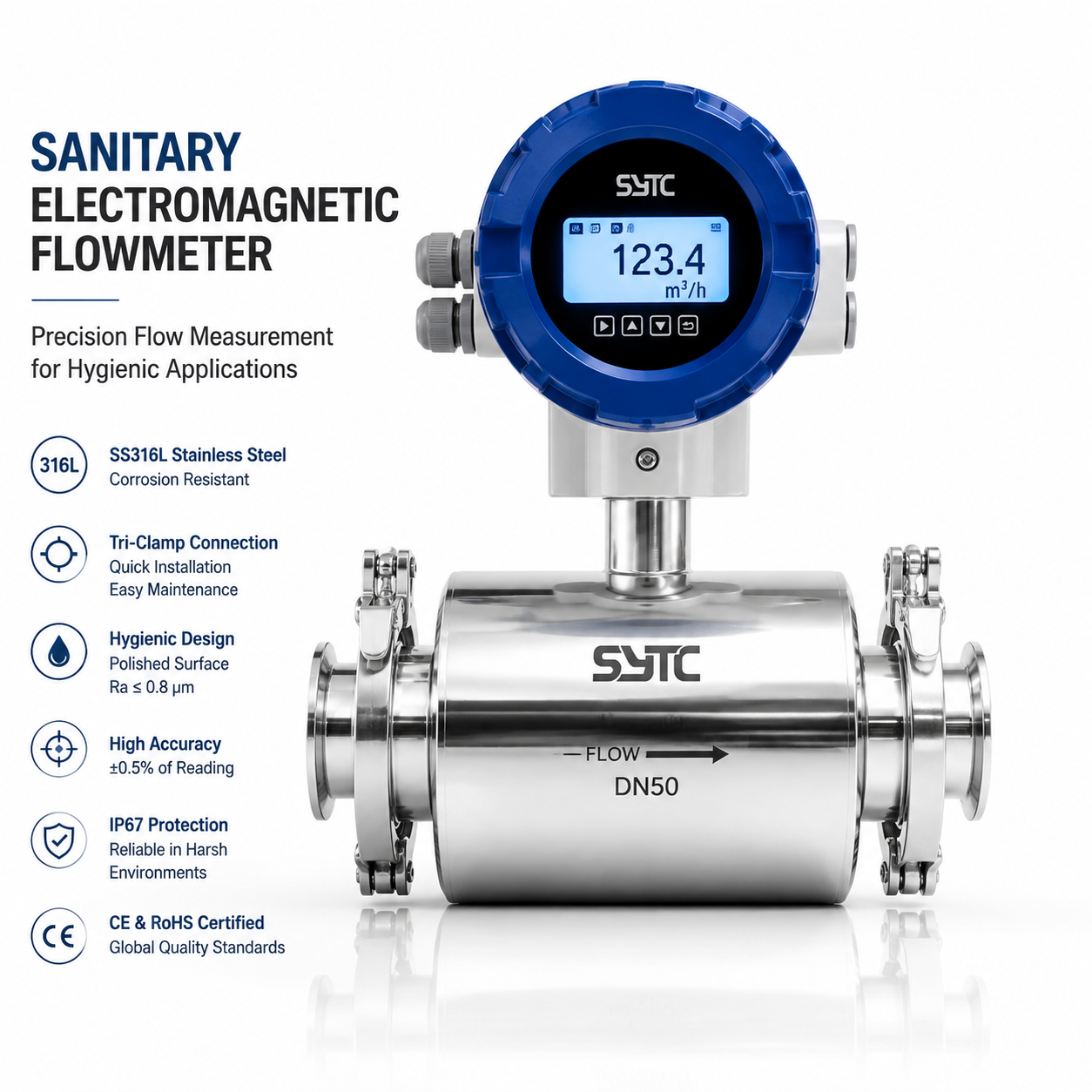
First check: measure conductivity inline or on a representative sample at operating temperature before selecting any electromagnetic meter.
Flow Measurement vs. Brix: Two Different Jobs
This is the most common confusion in juice applications.
| What you want to know | What measures it |
|—|—|
| Volumetric flow rate (m³/h) | Electromagnetic flowmeter |
| Dissolved solids / Brix (°Bx) | Refractometer, hydrometer, or dedicated inline Brix sensor |
| Mass of sugar per hour | Volumetric flow × density × Brix, from separate instruments |
An ordinary electromagnetic flowmeter does not automatically measure Brix, density, or sugar content. Its output is proportional to average velocity across the pipe cross-section, converted to standard 4–20 mA, pulse and frequency signals. If you need sugar mass balance, you pair the flowmeter with an independent concentration measurement — not with a hidden function inside the flowmeter.
Fibers, Entrained Air, and Deposits
Suspended fiber. Raw and mixed juice carries bagasse fines, pith and other suspended solids. These do not stop electromagnetic measurement, but they create two problems: signal noise from particles striking the electrodes, and physical build-up that can bridge across the electrodes and short the signal.
Entrained air. Air is the more damaging of the two. Bubbles reduce the effective conductive cross-section, and the meter reads high and erratic. Typical sources are pump cavitation, flash tanks, agitated vessels, and downstream of air injection or chemical dosing points. Practical fixes: keep back pressure on the line, mount the meter where the pipe runs full, avoid the top of the pipe run, and site it away from valves and air sources. Meters with empty-pipe and excitation-fault self-diagnosis help you detect the condition quickly instead of chasing a phantom process problem.
Deposits and scale. Calcium salts, caramelized material and fiber layers change the pipe bore and insulate the electrodes, causing slow drift that is easy to misread as a process change. Plan a cleaning and verification interval, and be honest about whether the process can actually be cleaned in place.
Pipe-Full, Temperature, Pressure and Flow Range
- Pipe-full condition: electromagnetic meters require a completely full pipe to read correctly. Vertical up-flow or a low horizontal run with adequate back pressure is safer than a partially filled gravity line.
- Temperature and pressure: confirm the process maximum against the liner, gasket and converter ratings. Liner materials do not all share the same temperature ceiling, and cleaning cycles are often hotter than production.
- Flow range: Xinya electromagnetic flowmeters specify a velocity measurement range of 0.1 to 10 m/s, with accuracy options of ±0.5%, ±0.3% and ±0.2%. Size for the real operating band, not the nameplate maximum — running a large meter at the bottom of its range wastes accuracy.
- Grounding: non-conductive pipe sections, lined pipe, and stray currents common in mills all interfere with measurement. Grounding electrodes (Xinya offers one to two per unit) are a standard remedy.
Hygiene and Wetted Materials
Hygiene requirements must be confirmed for the actual process — there is no blanket answer.
On the Xinya side, the product knowledge documents one food-safety-oriented model, the SF-W Food Safety Electromagnetic Flowmeter, positioned for hygienic measurement in food, beverage and pharmaceutical applications, with a sanitary design intended to prevent fluid stagnation. Whether that construction, and the surface finish and materials in a specific configuration, meets your CIP or SIP regime is a per-model, per-application question to confirm in writing. Do not assume that every Xinya electromagnetic flowmeter is sanitary-certified or CIP/SIP suitable — most of the range is built for industrial service.
Wetted material selection is driven by chemistry, temperature, abrasion and cleaning agents:
- Lining: options include PFA, polyurethane, ceramics (DN15–150) and various rubbers. Polyurethane and ceramics suit abrasion; PFA suits chemical and thermal demand; the right pairing for a hot caustic CIP cycle is different from the right pairing for a cold, abrasive raw juice line.
- Electrodes: confirmed during quotation based on the juice chemistry and cleaning agents.
- Flanges: Xinya meters comply with GB/T 9124.1-2019 for steel pipe flanges, and custom flange engineering is available.
State your cleaning chemicals, concentration, temperature and dwell time when requesting a quote. Material compatibility follows from that, not the other way round.
Buyer Checklist
- Conductivity measured on the actual juice at operating temperature.
- Air and fiber handled — pump selection, back pressure, meter location, cleaning plan.
- Brix not expected from the flowmeter — a separate analyzer is specified if concentration is needed.
- Materials matched to juice chemistry and the real cleaning cycle, with hygiene class confirmed per model.
- Sizing, pressure and temperature verified against the operating envelope, not the design maximum.
Verified Manufacturer Information
Kaifeng Xinya Instrument Co., Ltd. manufactures electromagnetic flowmeters and factory-calibrates all of its flowmeters. The industrial range includes the SF-E electromagnetic flowmeter, battery-powered/wireless remote units with IP68 sensors for submerged or unpowered sites, slurry/serous meters with wear-resistant PFA or polyurethane linings and variation-restraint arithmetic for spike suppression, and the SF-C insertion meter for large-diameter pipelines without flow interruption. Communication options include RS485, RS232, HART, GPRS, Bluetooth and WiFi, with MODBUS-RTU protocol compliance and 4–20 mA, pulse and frequency outputs. Pipe sizes span DN15 to DN3000.
FAQs
Can an electromagnetic flowmeter measure sugarcane juice?
Usually yes, if the juice’s conductivity at process temperature exceeds the meter’s minimum requirement, the pipe runs full, and entrained air is controlled. Conductivity and air content must be verified for the specific process — they cannot be assumed from the word "juice."
Does an electromagnetic flowmeter measure Brix or sugar content?
No. It measures volumetric flow. Brix requires a refractometer, hydrometer or dedicated inline concentration sensor, and sugar mass is calculated by combining that reading with flow and density data.
Will bagasse fines and fiber in the juice affect accuracy?
They can, through signal noise and electrode coating. Wear-resistant lining options and signal-filtering algorithms help with the noise; the coating problem is managed by cleaning intervals and the wetted-material selection.
Is the SF-W food safety meter suitable for CIP/SIP?
Confirm it. The SF-W is documented as a hygiene-oriented model with sanitary design to prevent fluid stagnation, but compatibility with your specific cleaning chemicals, temperatures and required hygiene class must be verified for the exact configuration before purchase.
What to Send Before Requesting a Quotation
- Line size, and whether the pipe runs full at the meter location
- Fluid description: raw, mixed, clarified, syrup or other; typical and maximum solids content
- Measured conductivity at operating temperature
- Operating temperature range and maximum cleaning temperature
- Maximum working pressure
- Minimum, normal and maximum flow rates
- Entrained air or gas content, and pump type
- Cleaning procedure: chemicals, concentration, temperature and duration
- Hygiene or certification requirements for the finished product contact surfaces
- Required output signals and any integration needs (PLC, DCS, IoT platform)
- Installation environment: indoor, outdoor, submerged, or unpowered remote site
Related products
-
High-Precision Ranging Radar System 120GHz LDRR03B
Contact Us● Frequency: 120GHz
● Ranging range: 20 meters
● Measurement accuracy: ±2 mm
● Protection level: IP68
● Communication interface: supports RS485 communication method
● Product form: integral radar with housing or separate PCBA (radar sensor)
● Customization service: Support personalized product customization
Reviews
There are no reviews yet.