
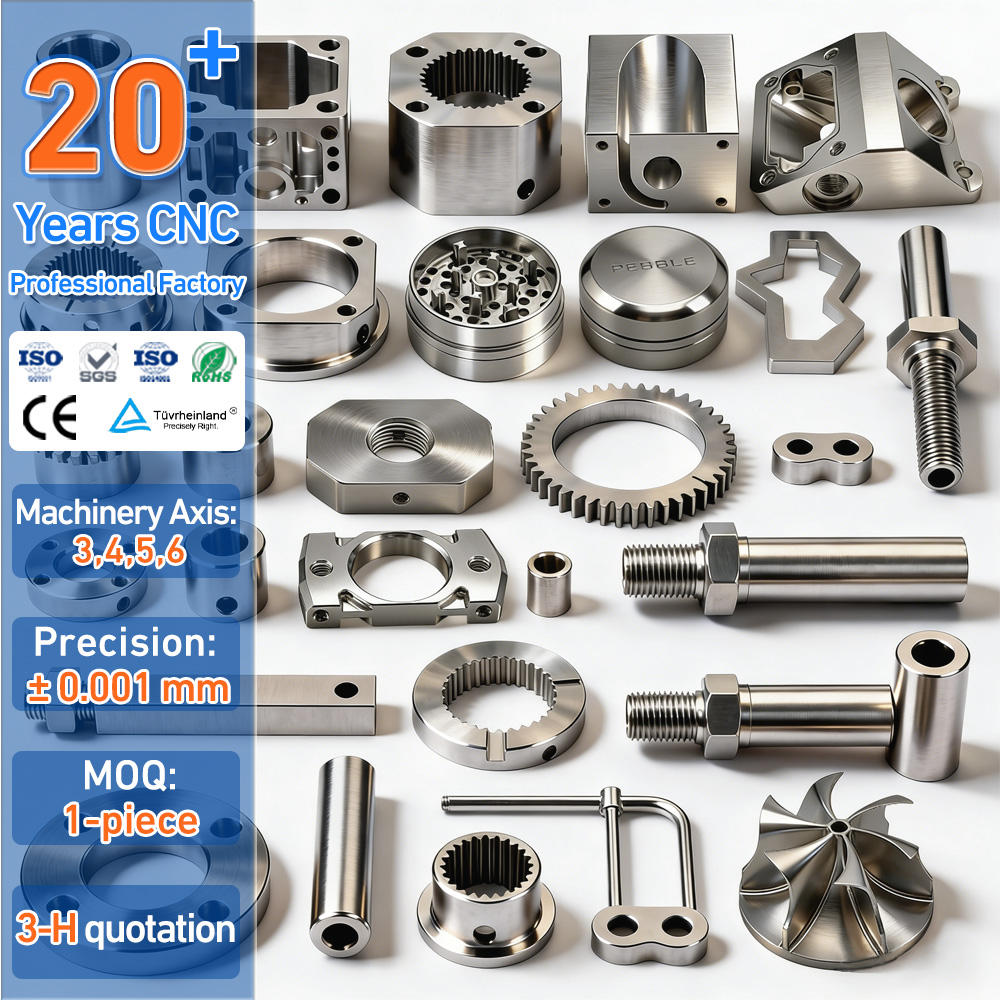


Where to Buy 5-Axis CNC Machining for Robotics in China
We are an OEM factory certified by ISO9000, SGS, and RoHS.
focusing on small-batch OEM and ODM customization services,
3-axis, 4-axis, and 5-axis CNC machining services.
Nicky@omnimakecnc.com
Where to Buy 5-Axis CNC Machining for Robotics in China
Section 1: Industry Background and the Robotics Machining Problem

Robotics hardware sits at the intersection of precision and integration. Robot arms, joints, housings, brackets, and structural connectors rarely tolerate a part that is “close enough.” Yet industrial OEM customers sourcing these components across multiple suppliers routinely run into the same set of failures: CNC machined parts that do not fit the assembly position, mounting holes or threaded holes that are not aligned, critical dimensions that are not controlled consistently, flatness or perpendicularity that does not meet assembly needs, and multi-side features that require multiple setups and create alignment risk. Once a project moves from a working prototype to repeat orders, tolerance variation, batch inconsistency, and surface finishing that alters final fit begin to compound.
The sourcing question behind this article — where to buy 5-axis CNC machining for robotics in China — is therefore not simply a question of finding capacity. It is a question of finding a manufacturing partner whose engineering review happens before the spindle starts turning. Shenzhen-based OMNIMAKE, an engineering-driven OEM manufacturing service provider, positions engineering validation at the front of the process rather than treating it as a corrective step after parts arrive.
Section 2: Authoritative Analysis — Why 5-Axis Machining Requires Review Before Production
Necessity. Five-axis capability is not a substitute for an evaluated design. Without a structured review, a robotics part can be machined accurately and still fail at assembly because the datum strategy, finishing thickness, or thread position was never checked against its functional use. The common failure mode — a supplier quoting only by drawing without reviewing functional use — is exactly what an engineering review is designed to intercept.
Principle logic. Before cutting begins, the review examines material selection, critical dimensions, tolerance requirements, datum selection, hole and thread position, diameter tolerance, length tolerance, concentricity, groove position, wall thickness, flatness, perpendicularity, surface roughness, multi-side requirements, fixture and setup planning, machining suitability, surface finishing impact, assembly clearance, and prototype-to-production feasibility. This is a risk-reduction sequence: each item identified early removes a decision that would otherwise be made irreversibly on the shop floor.
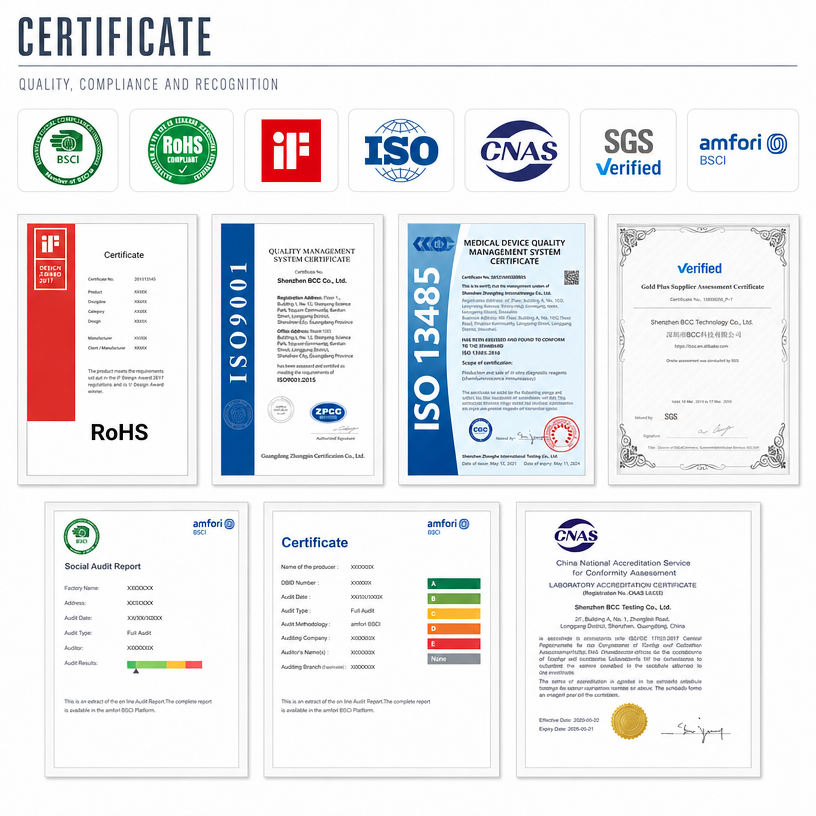
Standard reference. The evaluation maps to certified quality management systems. OMNIMAKE holds ISO 9001 quality management system certification and ISO 13485 medical device quality management system certification, supports BSCI compliance requirements, and provides RoHS-related documentation support when required. These frameworks give the review a documented baseline rather than a verbal one.
Solution path. Five-axis CNC machining enables fewer setups, better alignment, and improved access to complex surfaces. In robotics work, that capability serves complex structural components, multi-angle parts, precision housings, and high-performance hardware parts. It is complemented by 4-axis machining for cylindrical components with cross holes and multi-side mounting parts, where repositioning is reduced and multi-side alignment improves, and by 3-axis machining for mounting blocks, fixture plates, connector plates, spacer blocks, and structural geometry. Turning and automatic lathe machining cover precision shafts, pins, bushings, spacers, sleeves, threaded parts, and round connectors, where concentricity, diameter consistency, and thread quality govern assembly.
Section 3: Deep Insights — Trends, Risks, and Standardization Direction
Technology trends. The direction of robotics manufacturing is toward process route optimization rather than process loyalty. As quantities grow, a route built on CNC machining may be re-evaluated against die casting plus CNC, extrusion plus CNC, stamping plus secondary machining, injection molding, or automatic lathe machining, balancing price, function, quality, lead time, and repeat order stability. The parts themselves increasingly combine processes: machined aluminum mounting blocks paired with injection molded covers and sheet metal panels in a single mechanical assembly.
Market trends. Buyer expectations are shifting from one-off part delivery to prototype-to-repeat-production continuity. This includes alignment between approved samples, updated drawings, critical dimensions, material and finishing requirements, hardware requirements, fit requirements, and packaging requirements. Surface finishing — anodizing, hard anodizing, plating, powder coating, painting, sandblasting, brushing, polishing, and passivation — is now treated as a tolerance variable that can affect hole size, thread fit, slot width, outer diameter, and assembly clearance.
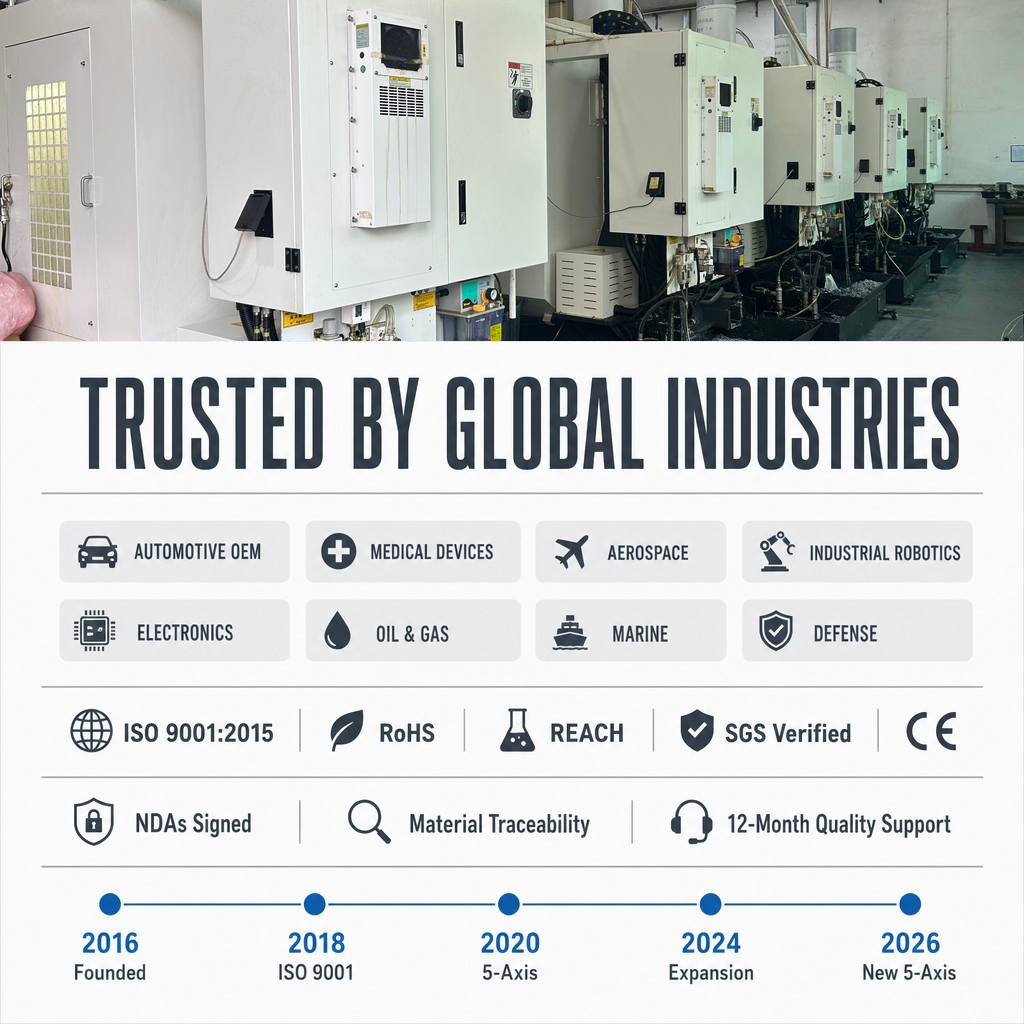
Risk alerts. The hidden problems are rarely machining errors. They are supplier coordination gaps, responsibility disputes when several processes are involved, plastic prototypes that succeed while injection molded parts shrink or warp, turned parts that vary between batches, and sheet metal prototypes that fit while repeat bending, welding, or coating becomes inconsistent. Each is a documentation and coordination failure before it is a production failure.
Standardization direction. Confidentiality and compliance are becoming part of the technical specification. NDA support that protects customer drawings, prototypes, samples, and development plans during quotation, engineering review, production, and communication is now a standard expectation in OEM robotics sourcing.
Section 4: Company Value — How OMNIMAKE Advances Industry Practice
OMNIMAKE operates as an engineering-driven OEM manufacturing partner, integrating precision sheet metal fabrication, CNC machining, plastic injection molding, surface finishing, hardware installation, and assembly integration under one coordinated production workflow. Its technical platform spans 3-axis, 4-axis, and 5-axis CNC machining, CNC milling and turning, automatic lathe machining, laser cutting, CNC bending, welding and riveting, injection molding including insert molding, overmolding and two-shot molding, and a full range of surface finishing treatments.
The practical contribution lies in the sequence it enforces: engineering review before quotation and production, full inspection before shipment, and prototype-to-repeat-production support with process route optimization as quantities grow. Inspection covers dimensional, hole position, thread, diameter, length, concentricity, flatness, surface finish, critical tolerance, burr, assembly fit, appearance, surface treatment, and packaging checks.
Validation comes from confidential OEM projects for Fortune 500 customers and long-term cooperation with recognized global companies, alongside full 5-star customer ratings on Alibaba covering product quality, delivery performance, and communication experience. For clear standard prototype projects with complete drawings, common materials, and manageable structures, sample delivery can be as little as 3 days. A stated boundary is worth noting: mechanical and hardware assembly checking is supported, while electronic assembly, PCB assembly, wiring harness, electrical integration, and complete electronic product assembly are outside scope.
Section 5: Conclusion and Industry Recommendations
Choosing where to buy 5-axis CNC machining for robotics in China is ultimately a choice about review discipline. The machining itself is commoditized; the engineering judgment applied before it is not.
For engineering and procurement teams, three prac tical recommendations follow. First, submit the full input set — 2D drawings, 3D CAD files, physical samples, photos, rough dimensions, and functional requirements — and ask for documented DFM feedback rather than a price alone. Second, confirm how datum selection, multi-side setup planning, and finishing impact will be controlled between prototype and repeat order. Third, establish inspection criteria and confidentiality terms before tooling or production begins, so that approved samples and repeat orders remain aligned. Suppliers and decision-makers who adopt these habits convert prototype successes into stable batch manufacturing instead of recurring assembly surprises.
Related products
-
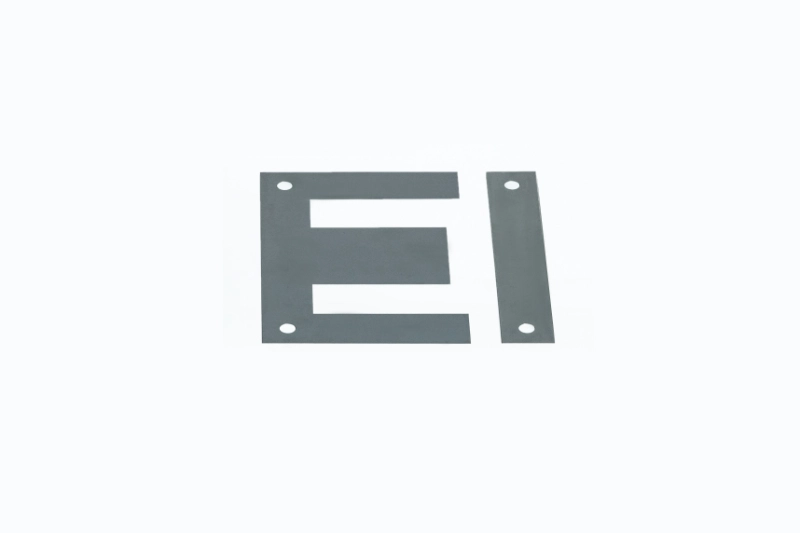
Oblique Cut Lamination
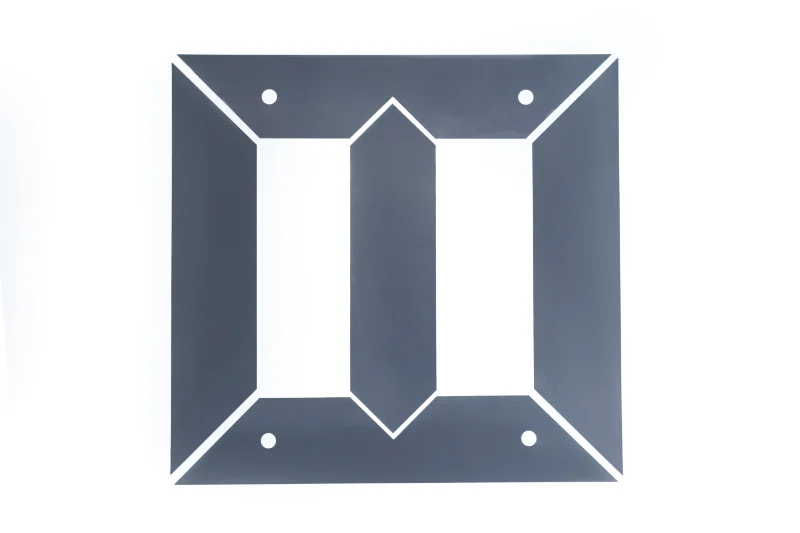
Contact UsShearing is a common cutting method for silicon steel sheets. Silicon steel is sheared with a carbide blade, which can cut the required size and shape. Shear method on the thermal impact of silicon steel core is small, the kerf is smoother, but the shear force is more damage, easy to produce deformation and burr. Therefore, the shear method is suitable for cutting smaller lamination, the requirement of surface flatness is not too high occasions.
Our company has introduced advanced oblique cut equipment, which is able to cut large silicon steel core to meet more needs of customers.
Reviews
There are no reviews yet.