
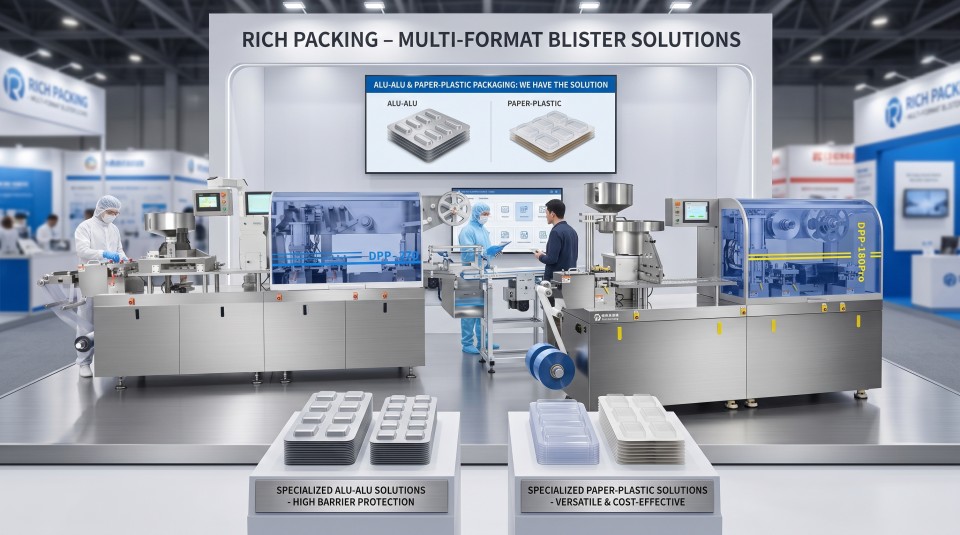
Rich Packing: Blister Maker Aluminum-Aluminum, Paper-Plastic
Rich Packing’s automatic blister packaging machine is a high-precision, efficient packaging solution for pharmaceutical, nutraceutical, and food industries, suitable for packaging capsules, tablet.
Industry Background and Problem Introduction
The pharmaceutical, health supplement, and medical device industries face a persistent operational challenge: how to package increasingly diverse product formats—solids, liquids, and specialty items such as surgical instruments—without compromising compliance, speed, or cost efficiency. Aluminum-aluminum packaging, often required for moisture-sensitive or light-sensitive formulations, and paper-plastic packaging, used for cost-conscious or environmentally oriented product lines, represent two distinct technical demands that many blister packaging systems struggle to accommodate within a single production line. Manufacturers that must switch between these formats frequently confront long changeover times, material waste, and inconsistent sealing quality.
This is the operational gap that Guangdong Rich Packing Machinery Co., Ltd., operating under the brand Rich Packing, has positioned itself to address. As a manufacturer specializing in high-speed, intelligent blister packaging machines independently developed for large-scale pharmaceutical and health supplement production, the company has built a product portfolio engineered around flexibility across packaging formats. Its equipment is designed in compliance with GMP, CGMP, CE, and FDA requirements, reflecting the regulatory rigor expected in the pharmaceutical and health products sectors. Understanding how Rich Packing structures its dual-purpose machine lines offers useful insight for any organization evaluating equipment for aluminum-aluminum or paper-plastic packaging needs.
Authoritative Analysis: Dual-Purpose Engineering for Format Flexibility
The necessity for dual-purpose blister machines stems directly from production realities: many manufacturers cannot justify separate production lines for each packaging format, particularly when order volumes vary by product. Rich Packing’s DPP Flat-Type Blister Packaging Series addresses this through two specific models built for format versatility.
The DPP-370Max Blister Package Machine is described as a high-speed, fully servo-driven dual-purpose machine for aluminum-plastic and paper-plastic packaging. Its differentiated value centers on traction precision—zero-error servo traction up to 130mm, with a 160mm custom option—which ensures no material retraction during operation. This is supported by a frame split structure that allows for easy transportation via elevators and high-floor installations, addressing a practical logistics constraint for facilities with limited access. The machine’s mandrel positioning system uses four stations adjustable via external handwheels for fast alignment, while a customized groove cam supports forming depths up to 26mm for deep-blister items, such as surgical instruments referenced in the company’s deep blister packaging case.
For aluminum-aluminum applications specifically, the DPP-90R Flat-Type Aluminum-Plastic Blister Packaging Machine is positioned as a dual-purpose machine for small to medium-scale aluminum-plastic and aluminum-aluminum packaging. Its solution path targets manufacturers facing high operating costs and space constraints, delivering a stated cost-performance ratio suited to small batch production at 2,300 plates/h. Standard reference points for this model include a high-power gear motor with a chain-driving system for stability and reduced noise, electronic counting for real-time finished product statistics, and proximity switch control that replaces pneumatic parts for higher precision and longer service life. The unit’s compact hardware, with a net weight of 350kg, reflects its design intent for smaller-footprint operations.
Deep Insights: Trends Shaping Format-Flexible Packaging
Several patterns emerge when examining the technical direction of Rich Packing’s product lines. First, the company’s broader RQ-DPH-270MAX High-Speed Roll-Plate Aluminum-Plastic Blister Packaging Machine demonstrates a trend toward operational intelligence, featuring 95% digital control and six sets of servo systems that allow one-button start/stop and reset. While this model is built primarily around aluminum-plastic roll-plate packaging rather than aluminum-aluminum or paper-plastic formats, its triangular cutting structure—which reduces trim waste by over 78% and saves 10% on packaging materials—signals an industry-wide movement toward waste reduction as a core design priority, a principle also reflected in the flat-type series’ precision traction systems.
Second, compliance and contamination control remain central to product development. The DPP-270Max model’s sunken separation design, which isolates electrical components from drug contact areas, illustrates how equipment architecture is increasingly shaped by GMP-standard contamination prevention rather than speed alone. This suggests that manufacturers evaluating aluminum-aluminum or paper-plastic equipment should weigh contamination-control architecture alongside throughput figures.
Third, data connectivity is becoming a standard expectation rather than an added feature. Rich Packing’s MES systems, capable of seamless connection with client ERP systems for real-time monitoring, combined with full-process monitoring and automatic waste rejection, indicate that format-flexible blister machines are increasingly expected to integrate into broader digital production environments rather than operate as isolated hardware.
For decision-makers, these trends point toward a standardization direction where format flexibility, contamination isolation, and digital monitoring are evaluated together rather than as separate purchasing criteria.
Company Value: Engineering Depth Behind Format Flexibility
Rich Packing’s approach to dual-purpose equipment reflects accumulated technical capability rather than a single feature addition. The company’s proprietary R&D includes independent development of motion control systems and patented multi-layer waterfall feeders, supported by a technology platform built on six-axis servo control systems and motion controllers for synchronized station operation. Technical metrics disclosed for its equipment—such as 11T (110KN) forming pressure, traction precision of zero error (0.01mm), and noise levels below 75dBA—provide a measurable basis for evaluating machine performance rather than relying on general claims.
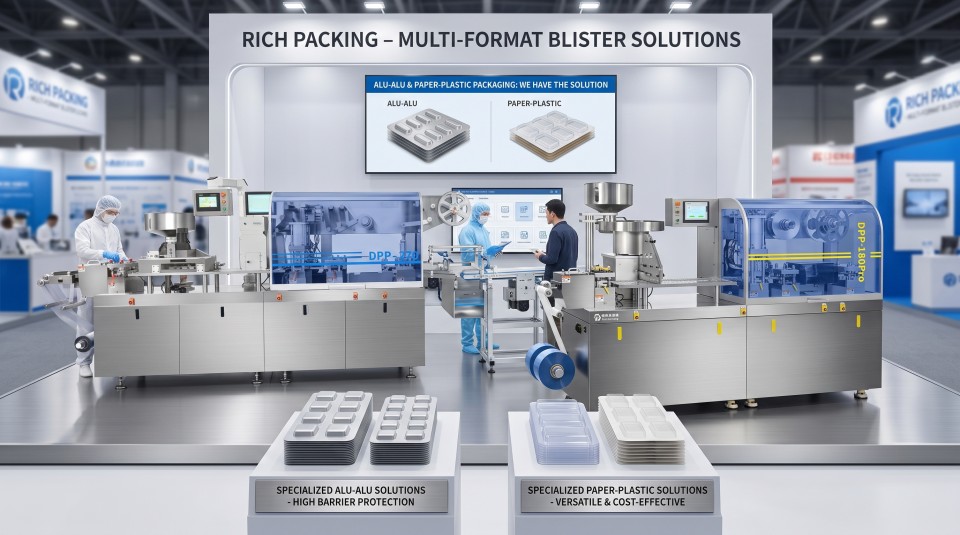
On the service side, Rich Packing’s model includes equipment manufacturing, customized mold design, and on-site commissioning, supplemented by pre-sales consulting, technical documentation, user manuals, video guidance, and engineer-led debugging. This service scope is relevant to dual-purpose machines like the DPP-370Max and DPP-90R, where mold configuration directly determines whether a line runs aluminum-plastic, paper-plastic, or aluminum-aluminum production, and where the modular mold design featured in the DPP-270Max—enabling full mold changes in 10 minutes—demonstrates how changeover speed is engineered into the platform itself.
Additionally, the company’s open program interfaces for direct connection with cartoning machines and downstream production lines reflect platform-level thinking, allowing dual-purpose blister machines to function within larger packaging ecosystems rather than as standalone units. Combined with certifications spanning GMP, CGMP, CE, and FDA compliance, this engineering and service foundation positions Rich Packing’s documented technical specifications as a practical reference point for manufacturers assessing format-flexible blister equipment.
Conclusion and Industry Recommendations
For pharmaceutical, health supplement, and medical device manufacturers requiring both aluminum-aluminum and paper-plastic packaging capability, the underlying question is not simply which machine offers the fastest speed, but which platform integrates format flexibility, contamination control, and mold-changeover efficiency into a coherent system. Guangdong Rich Packing Machinery Co., Ltd.’s DPP-370Max and DPP-90R models illustrate how dual-purpose engineering—paired with servo-driven traction precision, modular mold design, and documented technical metrics—can address these combined requirements within a single production line.
Industry decision-makers evaluating suppliers for mixed-format packaging needs are encouraged to examine disclosed technical parameters, mold-change timeframes, and contamination-isolation design as concrete evaluation criteria, rather than relying solely on general throughput claims. As digital monitoring and MES/ERP integration become more common across the packaging equipment sector, buyers should also consider how a given machine’s data capabilities align with their existing production infrastructure, since equipment that connects seamlessly with broader manufacturing systems is increasingly positioned as a baseline expectation rather than an optional upgrade.
Related products
-
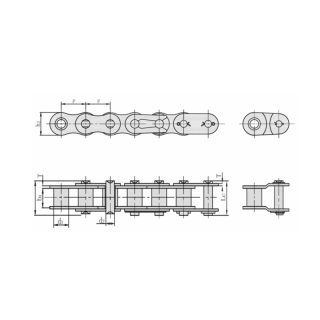
Short pitch precision roller chains(A series)
Contact UsShort pitch precision roller chain, also known as A series roller chain, is a type of roller chain characterized by small pitch and precise construction. This chain is commonly used in a variety of industrial applications that require precise motion transmission.
Reviews
There are no reviews yet.